



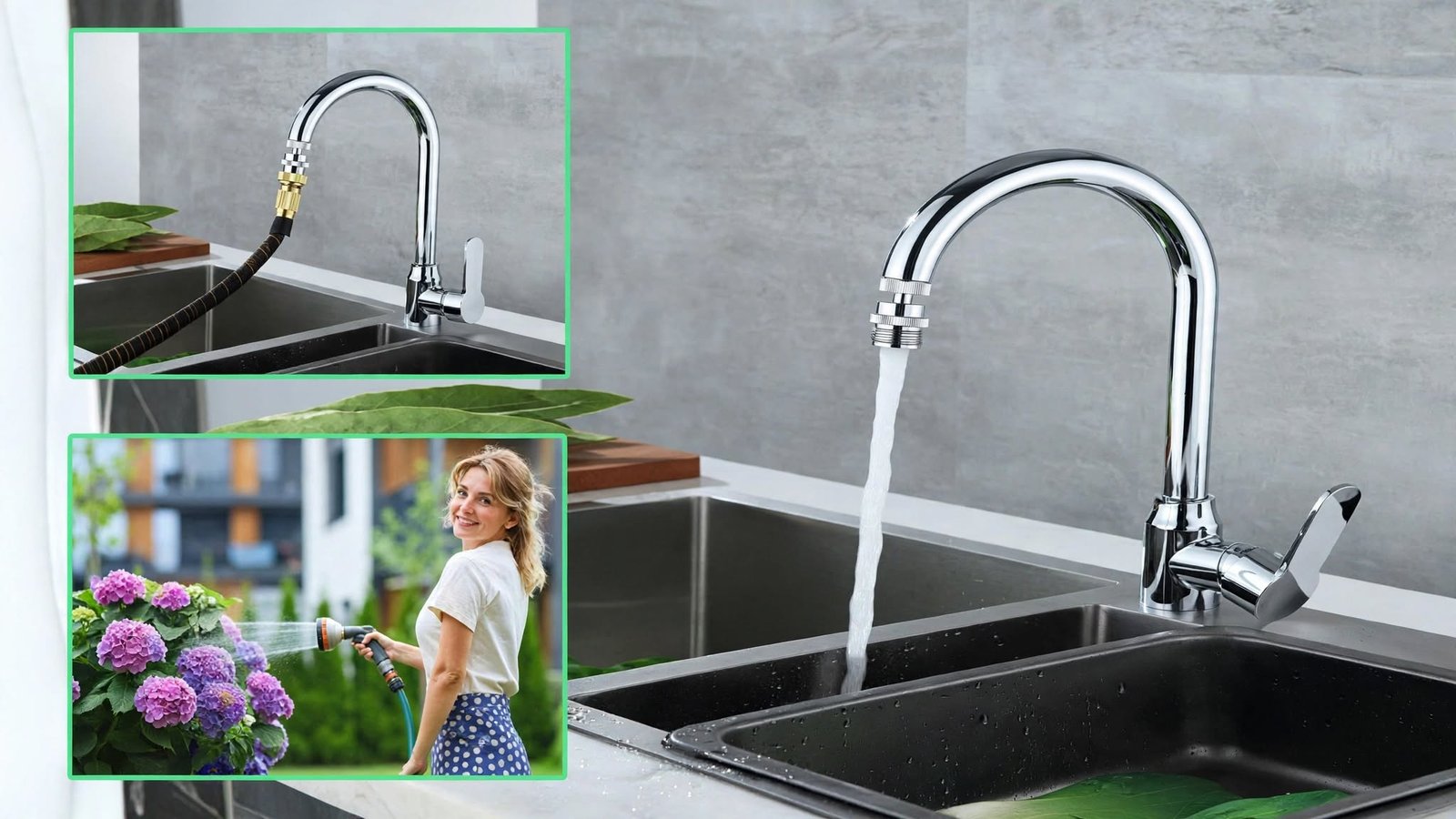
Choosing the right kitchen faucet to garden hose adapter depends on your faucet’s outlet design, thread size, and whether it has a removable aerator. The best adapter creates a secure connection between your kitchen tap and a garden hose without leaking, damaging the faucet, or requiring complicated modifications. Most standard kitchen faucets can work with a suitable adapter, but pull-down sprayers, pull-out faucets, and some modern designer taps may need a different solution.
Before purchasing an adapter, identify how your faucet is constructed and determine which connection type it uses. A few simple checks can help you avoid buying the wrong fitting and make the installation much easier.
What Is a Kitchen Faucet to Garden Hose Adapter?
A kitchen faucet to garden hose adapter is a small plumbing fitting designed to connect a kitchen sink faucet to a garden hose. It allows you to direct tap water through a hose for tasks such as filling buckets, watering indoor plants, rinsing muddy equipment, or cleaning items that are difficult to wash directly in the sink.
These adapters are available in several materials, sizes, and connection styles. Some screw directly onto the faucet after the aerator is removed, while others use quick-connect fittings or specialized connectors for faucets with unusual outlet designs.
The most important consideration is compatibility. An adapter that fits one kitchen faucet may not fit another, even if both faucets appear similar from the outside.
Which Adapter Is Compatible With Your Faucet?
The right adapter depends on your kitchen faucet’s design, outlet size, and connection type. By identifying these features before making a purchase, you can choose a compatible fitting that connects securely to your garden hose and helps prevent leaks during use.
Threaded Aerator Adapter
A threaded aerator adapter is usually the most practical choice for a kitchen faucet with a removable aerator. The aerator is the small component fitted to the end of the faucet spout that mixes air with the water and helps create a smoother stream.
Many aerators screw into or onto the faucet outlet. Once you remove the aerator, you can inspect the exposed threads and choose an adapter with the corresponding size and thread direction.
Some faucets have male threads on the spout, while others have female threads inside the outlet. An adapter may need to match the existing threads directly or include a suitable conversion fitting.
This type is a good starting point for standard fixed-spout kitchen faucets because installation is often straightforward. However, you should confirm the actual thread dimensions rather than relying on the faucet’s appearance.
Male and Female Thread Adapters
Male and female thread adapters help connect fittings with different connection designs. Male threads are located on the outside of a fitting, while female threads are found on the inside, allowing the two parts to screw together when their sizes and thread types match.
If your faucet has external threads, you may need an adapter with internal threads on the faucet side. If the faucet has internal threads, an adapter with external threads may be required.
The thread diameter, spacing, and direction must all match to ensure a secure, leak-free connection. Two connectors may appear to fit together but still leak or cross-thread if their specifications differ.
It is also important to distinguish faucet aerator threads from garden hose threads. They are not necessarily the same size or standard, so an adapter may need to convert between the two connection types.
Quick-Connect Faucet Adapter
A quick-connect adapter is useful when you want to attach and remove a hose frequently. Instead of repeatedly screwing the hose fitting on and off, you connect it using a compatible coupling mechanism.
This option can be convenient for occasional cleaning, filling containers, or other household jobs. Some quick-connect systems attach to a threaded faucet adapter, while others are designed for specific faucet models.
Before buying one, check that both sides of the connection are compatible. A quick-connect fitting intended for a garden hose does not automatically fit a kitchen faucet, and different quick-connect systems may not work together.
Adapters for Pull-Down and Pull-Out Faucets
Pull-down and pull-out kitchen faucets require extra attention because their spray heads are connected to flexible hoses. The removable spray head may use proprietary threads, internal valves, or quick-connect fittings that are different from those found on conventional faucet outlets.
In many cases, a standard aerator adapter will not fit the spray head. Even if the connector fits, the faucet’s internal mechanism may restrict water flow or prevent the garden hose from working as expected.
For these faucets, check the manufacturer’s specifications to determine whether an approved hose connection or accessory is available. If the spray head is not designed to accept an adapter, a separate utility faucet or another suitable water outlet may be a more reliable option.
Adapters for Faucets Without Removable Aerators
Some modern kitchen faucets have integrated aerators, unusually shaped outlets, or decorative spouts that do not accept conventional screw-on fittings. In these cases, you should not force a threaded adapter onto the outlet.
A clamp-style or specialty connector may work with certain faucet designs, but compatibility and water pressure limitations vary. These connectors may also be less secure than a properly matched threaded fitting.
If your faucet has a nonstandard outlet, identify its brand and model before shopping. A model-specific accessory or alternative water source may be safer and more practical than attempting to modify the faucet.
How to Find the Correct Adapter Size
Finding the correct size is one of the most important steps when choosing a kitchen faucet to garden hose adapter. Faucet aerator connections come in different diameters and thread configurations, while garden hoses commonly use their own standardized fittings.
Start by examining the faucet outlet. If the aerator is removable, unscrew it carefully and inspect the threads on both the faucet and the aerator. You can use a ruler or, preferably, a thread-measuring tool to determine the approximate diameter and pitch.
Next, check the garden hose connection. In North America, most standard garden hoses use a 3/4-inch Garden Hose Thread (GHT) connection.
which is different from many faucet aerator threads. Other countries may use different hose connectors or thread standards, so verify the fittings available in your area.
When shopping, look for an adapter that explicitly identifies both ends of the connection. A product description should specify the faucet-side thread, the hose-side thread, and any included conversion pieces. If the specifications are unclear, compare the measurements or consult the faucet manufacturer before purchasing.
Materials: Which Adapter Is Best?
The material of an adapter affects its durability, resistance to corrosion, and ability to withstand repeated installation. Brass adapters are often a dependable choice because they are generally durable and suitable for regular household use.
Stainless steel can also offer good corrosion resistance, although the quality and design of the fitting still matter. Plastic adapters are typically lightweight and may cost less, making them suitable for occasional use when they are properly sized and rated for the intended water pressure.
Regardless of material, inspect the threads, sealing surfaces, and included washers. A well-made adapter with a properly fitted gasket is usually more useful than a cheaper fitting that repeatedly leaks or becomes difficult to remove.
Choose a connector intended for potable-water plumbing if the water may be used for drinking or food preparation. Also consider the intended use of the hose, especially if it will be used for gardening or other outdoor tasks.
How to Install a Kitchen Faucet to Garden Hose Adapter
Installing an adapter on a compatible fixed-spout faucet is generally a simple process. Begin by turning off the faucet and placing a cloth or small container in the sink to catch any remaining water or loose parts.
If the faucet has a removable aerator, unscrew it by hand. If it is tight, use a suitable aerator tool or a wrench with a protective cloth to avoid scratching the finish. Do not apply excessive force, as the aerator housing or faucet threads can be damaged.
Once the aerator is removed, clean the outlet and inspect the threads for mineral buildup, debris, or damage. Fit the adapter according to the manufacturer’s instructions, ensuring that the correct gasket or washer is in place. Tighten it securely by hand unless the instructions specify otherwise; overtightening can damage the threads or compress the seal incorrectly.
Connect the garden hose to the adapter and make sure its washer is properly seated. Turn the faucet on slowly and check the connection for leaks before using the hose at full flow.
If water escapes around the faucet connection, turn off the tap and inspect the gasket, thread match, and adapter alignment. Do not attempt to solve a mismatched connection simply by tightening it harder.
How to Prevent Leaks and Poor Water Flow
Leaks usually occur because the adapter has the wrong thread size, the gasket is missing, or the connection has not been aligned correctly. In some fittings, the seal is created by a rubber washer rather than by the threads themselves, so adding excessive thread-sealing tape may not solve the problem.
Check the instructions supplied with the adapter to determine whether a washer, O-ring, or thread sealant is required. Make sure the sealing surface is clean and that the connector sits straight on the faucet outlet.
Water flow can also be affected by the faucet’s internal design, a restrictive adapter, a long hose, or a spray-head mechanism that is not intended for continuous hose use. If the flow is weak, inspect the hose for kinks and check whether the adapter opening is narrower than the faucet outlet.
Never force a connection that does not fit smoothly. A damaged faucet thread can be difficult to repair and may turn a simple household project into a costly plumbing problem.
Can You Use a Garden Hose With Any Kitchen Faucet?
No, not every kitchen faucet is compatible with a garden hose adapter. Standard fixed-spout faucets with removable aerators are generally the easiest candidates because their outlet connections are accessible and easier to measure.
Pull-down sprayers, pull-out faucets, integrated aerators, and unusual designer outlets may require specialized fittings or may not support a garden hose connection at all. Compatibility also depends on the adapter’s pressure rating and the faucet manufacturer’s design limitations.
You should also consider whether the faucet is intended to supply water through an external hose. Some kitchen faucets contain internal components that may not perform correctly when connected to certain hose fittings, so a compatible physical thread alone does not guarantee a suitable installation.
If you cannot identify a compatible adapter, consider using a dedicated utility sink faucet, an outdoor tap, or another water outlet designed for hose connections.
Common Mistakes to Avoid When Buying an Adapter
One of the most common mistakes is assuming that all kitchen faucets use the same thread size. Even faucets from the same manufacturer may have different outlet designs, so measuring the connection or checking the model specifications is essential.
Another mistake is buying an adapter based only on its advertised garden hose size. The hose-side connection may be correct while the faucet-side connection is completely incompatible. Always verify both ends before ordering.
Ignoring the sealing washer can also lead to frustrating leaks. A connector may screw into place correctly but still fail to seal if the washer is missing, damaged, or the wrong size.
Finally, avoid using excessive force or improvised fittings to make an adapter fit. A secure, correctly matched connection is more reliable than one held together by overtightening or makeshift modifications.
Is a Kitchen Faucet to Garden Hose Adapter Worth Buying?
A kitchen faucet to garden hose adapter can be a useful, affordable accessory when you need temporary access to a hose near your sink. It can simplify small cleaning jobs, help fill large containers, and make certain household tasks more convenient without requiring permanent plumbing changes.
Its value depends on how often you need the connection and whether your faucet supports a suitable fitting. For occasional use, a correctly sized threaded adapter may be all you need. For frequent outdoor watering or high-flow cleaning, a dedicated outdoor faucet or utility connection may provide better convenience and reliability.
Before purchasing, compare the cost of the adapter with the time and effort needed to install and remove it. If your faucet requires a complicated or model-specific connector, a separate water outlet may be the more practical long-term choice.
Final Thoughts
The right kitchen faucet to garden hose adapter is the one that matches your faucet’s outlet, thread dimensions, and connection design while providing a secure, leak-resistant seal. For most conventional kitchen faucets, a threaded aerator adapter is a sensible place to start, but pull-down sprayers and nonstandard outlets require closer inspection.
Take a few minutes to identify your faucet type, measure the connection, and confirm the garden hose fitting before buying. With the correct adapter and careful installation, you can create a convenient temporary hose connection while reducing the risk of leaks, damaged threads, and unnecessary plumbing expenses.

2 Comments
Pingback: Cultivated Garden Benefits: How Growing a Garden Can Improve Your Home and Lifestyle
Pingback: Bonita Fashion USA: Explore Fashion Styles for Every Occasion