



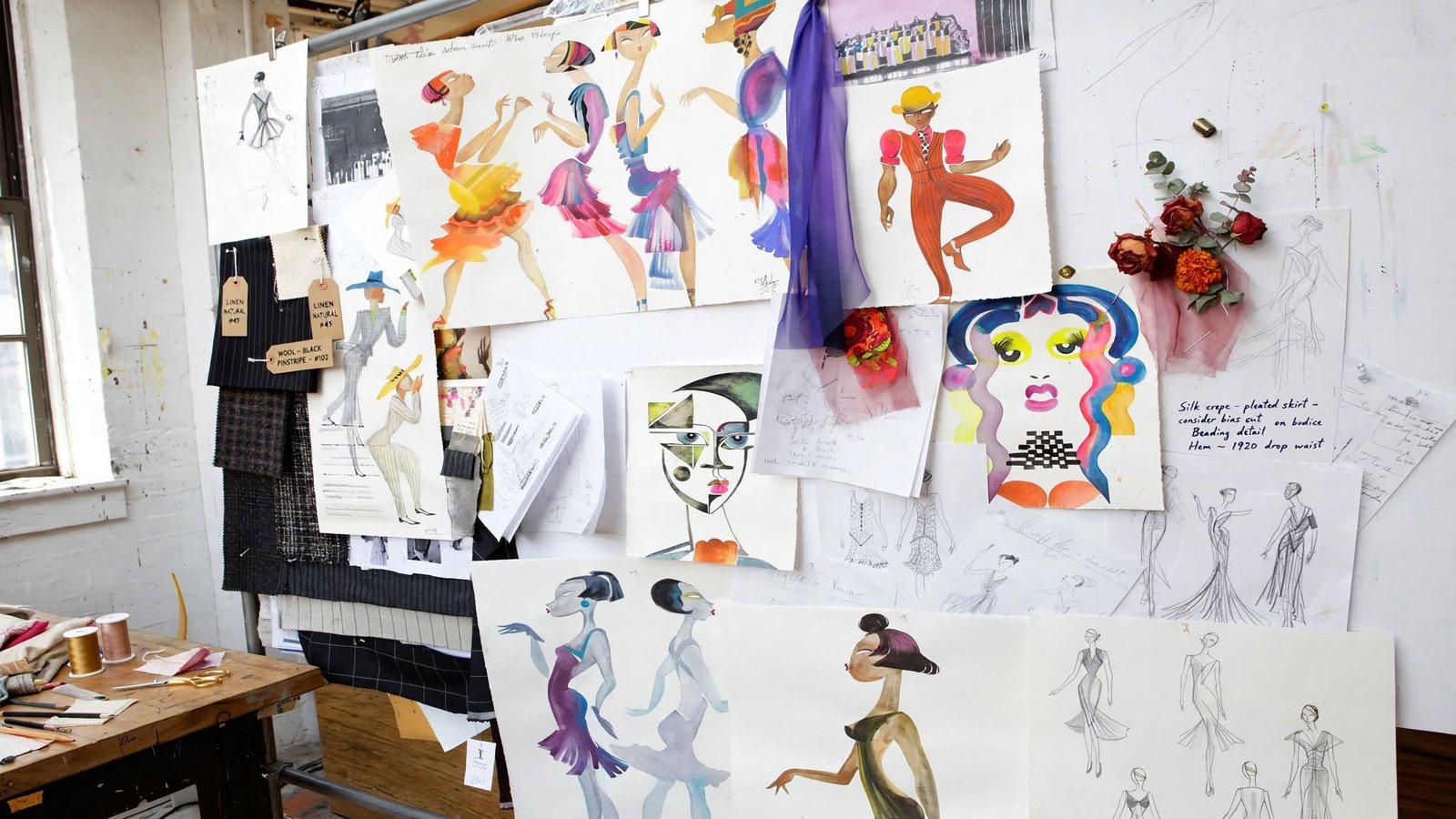
Ruben Toledo artwork is celebrated for its imaginative approach to fashion, expressive illustrations, vibrant colors, and playful blend of art and culture. His creations transform everyday observations about clothing, beauty, and human behavior into distinctive visual stories that feel theatrical, humorous, and full of personality.
Ruben Toledo is a Cuban-American artist known for his work as an illustrator, painter, sculptor, and fashion chronicler, blending creativity, culture, and imagination to create a distinctive style that goes beyond conventional fashion illustration. Through drawings, watercolors, paintings, murals, and design collaborations, he explores how fashion reflects identity, society, and the changing spirit of the times.
What makes his work especially compelling is its ability to capture more than the appearance of a garment or a fashionable figure. His illustrations suggest movement, emotion, character, and imagination, inviting viewers to discover a world in which fashion becomes a form of visual storytelling.
Who Is Ruben Toledo?
Ruben Toledo is a Cuban-American multidisciplinary artist born in Havana, Cuba, who moved to the United States with his family during childhood and developed his creative career in New York City. He became known for his distinctive illustrations and his ability to connect fashion with fine art, popular culture, humor, and theatrical expression.
Rather than limiting himself to one artistic discipline, Toledo has explored numerous creative forms, including painting, drawing, sculpture, graphic design, animation, and writing. His work demonstrates a fascination with the way people present themselves to the world and how clothing can communicate personality, social status, cultural influences, and individual imagination.
His career has also been closely connected to the fashion industry through collaborations with publications, designers, retailers, and creative institutions. His illustrations have appeared in prominent fashion and editorial settings, while his wider artistic practice has included murals, hand-painted objects, mannequins, and furniture.
This versatility helps explain why Ruben Toledo artwork appeals to audiences beyond fashion enthusiasts. His creations occupy a space between illustration, contemporary art, design, and cultural commentary, offering different ways to appreciate the relationship between visual expression and everyday life.
What Makes Ruben Toledo Artwork Unique?
The defining quality of Ruben Toledo artwork is its combination of expressive drawing, imaginative exaggeration, visual humor, and a deep understanding of fashion. His figures often appear elongated, animated, and almost dreamlike, while their poses and silhouettes suggest the movement of models walking a runway or characters performing on a theatrical stage.
Instead of reproducing clothing with strict photographic precision, Toledo often emphasizes the qualities that make a design memorable. A dramatic sleeve, an unusual silhouette, a sweeping skirt, or an exaggerated posture can become the central element of an illustration, allowing the viewer to understand the garment’s character without needing every detail to be represented.
His work also draws on surrealist sensibilities, using unexpected proportions and imaginative combinations to create images that are both sophisticated and playful. A fashionable figure may appear elegant at first glance, yet closer inspection can reveal a humorous gesture, an unusual shape, or a subtle visual joke.
Color plays an equally important role. Bold tones, delicate washes, contrasting shades, and expressive lines help establish the atmosphere of each composition, giving individual works a distinctive rhythm and emotional quality.
What ultimately separates Toledo’s art from conventional fashion drawing is the personality behind the image. His illustrations are not simply records of clothing; they interpret the energy, contradictions, and cultural significance of fashion through an individual artistic perspective.
The Influence of Fashion on His Artistic Style
Fashion is one of the most important subjects in Toledo’s creative world, but his relationship with it extends beyond trends, designer labels, and seasonal collections. He approaches fashion as a constantly changing expression of human identity, using clothing to explore how people communicate through appearance, movement, and personal style.
His illustrations often capture the transformation that occurs when fabric becomes part of a person’s identity. The angle of a shoulder, the shape of a hat, or the dramatic sweep of a dress can suggest confidence, eccentricity, elegance, or rebellion without relying on written explanations.
Toledo’s interest in the fashion world developed significantly through his relationship with his wife, the late fashion designer Isabel Toledo. Their long-standing creative partnership brought together two complementary perspectives: Isabel’s experimental approach to garment construction and Ruben’s talent for translating shapes, textures, and ideas into expressive visual compositions.
He developed a close understanding of how clothing is constructed, how fabric behaves, and how a designer’s intentions can be communicated through shape. This knowledge gives his illustrations a distinctive balance between artistic freedom and an appreciation for the practical details of fashion design.
Their collaboration also illustrates how fashion and art can influence one another. A garment can inspire an illustration, while the illustration can offer a new perspective on the garment, revealing qualities that might otherwise go unnoticed.
Exploring the Colors and Techniques of Ruben Toledo Artwork
Color is central to the atmosphere of Ruben Toledo artwork, helping transform a simple drawing into an expressive and memorable composition. His use of color can be bold and dramatic or subtle and fluid, depending on the subject and the feeling he wants to convey.
Watercolor is particularly well suited to his visual language because it allows him to combine controlled lines with transparent washes and spontaneous marks. These qualities create a sense of movement and immediacy, making figures appear alive rather than rigidly constructed.
Ink and drawing also play an important role in his work. A few carefully placed lines can establish the shape of a body, the structure of a garment, or the attitude of a character, while areas of color add depth and visual emphasis.
The relationship between precision and spontaneity is especially interesting. Although his figures may appear exaggerated or whimsical, their compositions frequently depend on an understanding of proportion, gesture, balance, and visual rhythm.
Toledo’s broader artistic practice also includes painting and work on objects, allowing his imagery to move beyond paper and into physical spaces. This range of techniques demonstrates that his style is not tied to a single medium; it is defined more by his imaginative approach to subjects and his distinctive way of seeing the world.
The Role of Surrealism, Humor, and Imagination
One of the most engaging aspects of Ruben Toledo artwork is its playful relationship with reality. His figures and compositions can feel recognizable while simultaneously suggesting an imaginary world where proportions are flexible, movement is exaggerated, and ordinary fashion conventions become opportunities for creative experimentation.
Surrealist influences are evident in the unexpected qualities of his imagery, although his work also incorporates satire, theatricality, and the visual language of popular culture. These elements help his illustrations communicate ideas without becoming overly literal or predictable.
Humor is particularly important because fashion is often associated with glamour, luxury, and seriousness. Toledo introduces a more playful perspective, observing its rituals and eccentricities with curiosity rather than simply celebrating its polished appearance.
His artistic approach can reveal the theatrical side of getting dressed, the strange beauty of unusual silhouettes, and the way personal style can become a form of performance. A figure’s posture or an exaggerated accessory may communicate as much about character as the clothing itself.
This combination of wit and sophistication makes his work rewarding to revisit. An image can initially attract attention through its color or shape, then reveal additional meaning through its details, gestures, and subtle observations about human behavior.
Style Dictionary: A Distinctive View of Fashion
An important part of Toledo’s artistic legacy is Style Dictionary, a book that brings together his observations about fashion through drawings and watercolors. Rather than treating style as a rigid set of rules, the work presents it as a lively collection of ideas, characters, visual references, and cultural associations.
The book demonstrates how illustration can interpret fashion in a way that is both informative and entertaining. Its imagery captures the peculiarities of clothing and style while acknowledging that fashion is shaped by imagination, social expectations, historical influences, and individual expression.
Toledo’s approach is especially effective because he does not need to explain every observation in lengthy descriptions. The drawings themselves communicate much of the humor and insight, allowing readers to explore the relationship between appearance and personality visually.
Style Dictionary also reflects his ability to move between artistic observation and cultural commentary. Fashion becomes a subject that can be examined, questioned, celebrated, and gently mocked, all within the same creative framework.
For anyone interested in Ruben Toledo artwork, the book offers a useful introduction to the qualities that make his illustrations distinctive: expressive linework, imaginative figures, an appreciation for fashion history, and a willingness to find artistic possibilities in unexpected places.
Ruben Toledo and Isabel Toledo: A Creative Partnership
The relationship between Ruben Toledo and Isabel Toledo is an important part of understanding his artistic development. Their partnership brought together illustration and garment design in a sustained creative exchange that influenced both their individual practices.
Isabel was known for her experimental approach to fashion construction, developing garments through an intimate understanding of fabric, shape, and movement. Ruben complemented this process by translating ideas and forms into drawings, helping visualize concepts and explore the expressive possibilities of clothing.
Their collaboration was not simply a matter of an illustrator documenting a designer’s finished work. The exchange between them was more dynamic, with shapes, materials, techniques, and visual ideas moving between their respective creative processes.
Ruben’s illustrations could reflect the structure of Isabel’s garments, while her designs could draw inspiration from the shapes and artistic ideas emerging from his work. This mutual influence helped create a distinctive connection between the physical construction of fashion and its representation on paper.
Their partnership demonstrates how collaboration can deepen an artist’s understanding of a subject. It also shows that fashion illustration can serve as more than a promotional tool: it can become an active part of the design process, helping ideas develop and encouraging new ways of seeing.
From Fashion Illustrations to Murals, Sculpture, and Design
Although fashion illustration remains one of the most recognizable aspects of Ruben Toledo artwork, his creative output extends well beyond drawings of models and garments. His work across painting, sculpture, murals, and design reveals a sustained interest in transforming images into different forms and environments.
His long-running association with Ralph Pucci is a notable example of this versatility. Toledo began designing mannequins for the company and subsequently contributed imaginative artwork to furniture and other design objects, bringing his visual style into three-dimensional settings.
This transition from paper to physical objects changes how viewers experience his work. An illustration can be studied closely as a contained image, while artwork on furniture or other objects becomes part of an environment, interacting with architecture, materials, and everyday activities.
Murals offer another opportunity for his imagery to occupy larger spaces. At this scale, line, color, composition, and visual storytelling can become part of a building’s atmosphere rather than remaining confined to a page.
These different formats reveal a consistent principle in Toledo’s work: artistic expression does not need to belong to a single category. Drawing, painting, sculpture, and design can operate as connected ways of communicating ideas, each offering different possibilities for engaging an audience.
The Cultural Influences Behind His Artwork
Toledo’s artistic identity reflects an intersection of Cuban heritage, American popular culture, New York’s creative environment, and his long engagement with fashion. These influences do not appear as a simple collection of references; instead, they contribute to the energy, humor, and visual complexity of his work.
His background gives his art a personal cultural dimension, while his professional life in New York placed him within a setting shaped by fashion, publishing, theatre, design, and contemporary art. This mixture provided a rich source of characters, styles, visual contrasts, and everyday observations.
His illustrations often suggest that fashion is not isolated from the rest of society. Clothing can reflect cultural change, personal aspiration, social conventions, and the desire to stand apart from the crowd.
By combining observation with imaginative interpretation, Toledo transforms these influences into images that are accessible without being simplistic. Viewers do not need extensive knowledge of fashion history to appreciate the expressive figures or striking colors, although that knowledge can reveal additional layers of meaning.
This cultural range is one reason his work continues to interest audiences across disciplines. Fashion enthusiasts may notice the silhouettes and garments, while art lovers may focus on composition and technique, and design professionals may appreciate the way he translates ideas between different creative fields.
Why Ruben Toledo Artwork Continues to Attract Attention
The enduring appeal of Ruben Toledo artwork lies in its ability to combine visual pleasure with thoughtful observation. His illustrations are colorful and entertaining, but they also reflect a broader understanding of how people use fashion and appearance to express themselves.
In an age when images are frequently produced and consumed at great speed, his expressive approach offers a reminder of the value of individual perspective. His work emphasizes the human hand, the character of a line, and the small irregularities that make an image feel personal rather than mechanically perfect.
His art also remains relevant because fashion itself is continually changing. Trends disappear, silhouettes return, and cultural ideas evolve, but the underlying relationship between clothing and identity remains a compelling subject for artistic exploration.
Toledo’s work captures this tension between change and continuity. Individual fashions may belong to particular moments, yet the gestures, personalities, humor, and imagination within his illustrations can continue to resonate long after a trend has passed.
His willingness to move between illustration, fine art, and design also gives his work a lasting sense of creative freedom. Rather than allowing professional categories to define his practice, he treats different mediums as opportunities to explore the same fundamental interest in people, style, and visual communication.
How to Appreciate and Collect Ruben Toledo Artwork
For those interested in exploring Ruben Toledo artwork, the most useful starting point is to look beyond the subject of a particular illustration and consider how the image is constructed. Pay attention to the lines, the posture of the figures, the relationship between color and empty space, and the details that make the composition feel animated.
It is also worth examining how his work changes across mediums. A watercolor illustration, a painting, a mural, and an artwork applied to furniture may share recognizable qualities, but each format presents different opportunities for texture, scale, and visual impact.
People interested in collecting his work should distinguish between original artworks, signed prints, published illustrations, and commercially produced objects featuring his imagery. These categories can differ considerably in provenance, rarity, materials, and market value.
Before purchasing a work, it is sensible to establish its authenticity, identify the medium, review any available documentation, and understand whether the piece is an original or a reproduction. Provenance and condition can be particularly important when assessing an individual artwork, and prices should be evaluated in relation to comparable works rather than artistic reputation alone.
For admirers who are not looking to purchase art, books featuring his illustrations, exhibition catalogues, and professionally published reproductions can provide accessible ways to study his visual language. The important thing is to approach each work with curiosity, noticing how its imagery communicates through shape, color, gesture, and personality.
The Lasting Artistic Legacy of Ruben Toledo
Ruben Toledo’s contribution to art and fashion lies in his ability to treat illustration as a flexible, expressive medium capable of communicating ideas about much more than clothing. His work connects fashion with fine art, popular culture, humor, design, and the complex ways people present themselves to the world.
Through his distinctive figures, imaginative compositions, and expressive use of color, he has developed an artistic language that is recognizable without being confined to a single subject or medium. His work demonstrates that fashion illustration can possess the visual richness of fine art while retaining its connection to everyday life and cultural change.
His creative partnership with Isabel Toledo further illustrates the value of collaboration, showing how two different artistic disciplines can inspire one another and generate new possibilities. Their shared history remains an important part of the story behind his work, particularly in the way drawing and garment construction informed their creative exchange.
Ultimately, Ruben Toledo artwork turns fashion, fantasy, and color into visual stories that are both entertaining and insightful. Its lasting appeal comes from the combination of technical understanding, imaginative freedom, cultural awareness, and a distinctly human sense of humor.
For viewers willing to look closely, his art offers more than a glimpse into the world of fashion. It opens a window onto the personalities, ideas, and creative possibilities that make visual expression such a powerful part of everyday life.

1 Comment
Pingback: 270 W 39th Street: Is This the Ideal Location for Work or Business in NYC?