


Finding accurate B2B contact data is one of the biggest challenges in modern outbound sales. Companies can have excellent products, carefully designed messaging, and experienced sales representatives, but none of that matters if the sales team is working from outdated email addresses, incorrect job titles, incomplete company records, or the wrong decision-makers.
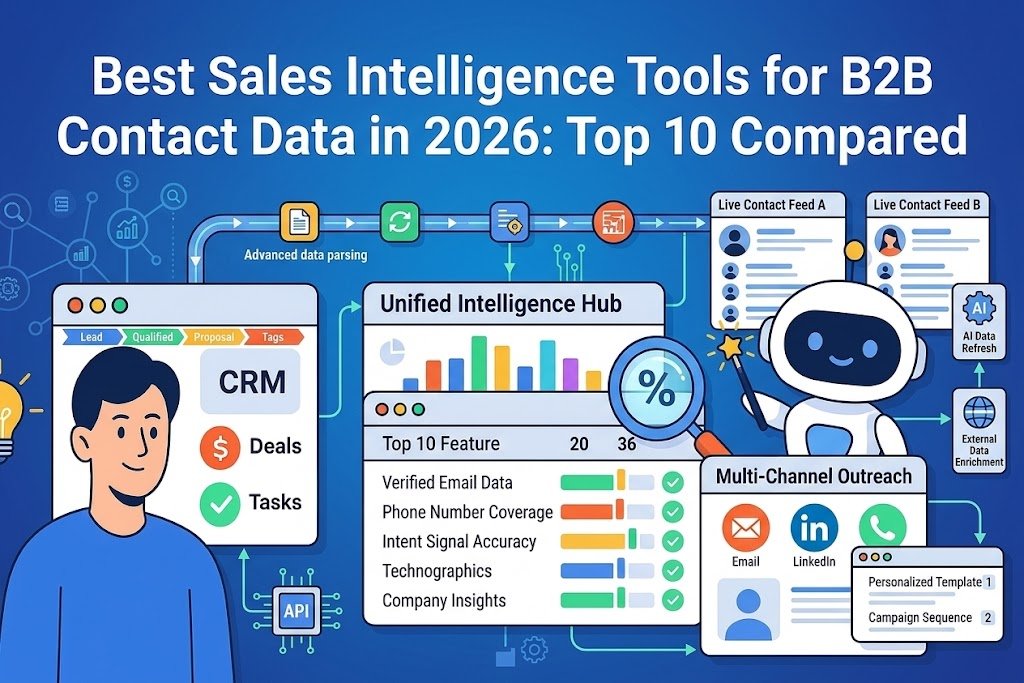
In 2026, sales intelligence platforms have evolved far beyond simple contact databases. The strongest tools combine business contact information with firmographic data, enrichment, buying signals, intent data, workflow automation, CRM integrations, and increasingly sophisticated AI capabilities.
The category now includes everything from enterprise databases to flexible data-enrichment platforms and all-in-one prospecting solutions. The right choice depends on your target market, budget, geographic focus, sales process, and the type of data your team actually needs.
What Is a Sales Intelligence Tool?
A sales intelligence tool is software that helps revenue teams discover, research, qualify, and prioritize potential business customers. At its most basic level, the platform provides contact information such as professional email addresses, phone numbers, job titles, company names, industries, employee counts, and locations.
Modern sales intelligence platforms increasingly add another layer of information around those contacts. This can include company revenue, technology usage, hiring activity, funding events, job changes, website activity, intent signals, organizational changes, and other indicators that can help salespeople determine whether an account is worth pursuing.
The distinction between a B2B contact database and a sales intelligence platform has consequently become less important. A database primarily answers “Who can I contact?” while sales intelligence attempts to answer “Who should I contact, why now, and how should I reach them?”
For sales teams, this difference is significant. A database can produce thousands of contacts, but a sales intelligence platform can potentially turn those records into prioritized prospects and automated workflows.
How We Compared the Best B2B Contact Data Tools
The most important factor in evaluating B2B data is not the headline number of records. A database can contain hundreds of millions of contacts and still perform poorly for a particular industry, geography, or job function.
Data accuracy, geographic coverage, direct-dial availability, email verification, refresh frequency, search filters, enrichment capabilities, CRM integrations, compliance, and workflow automation all influence the practical value of a platform.
Pricing is another important consideration, although direct comparisons can be difficult because enterprise platforms frequently use custom contracts, while self-service products publish monthly or annual plans.
For that reason, the rankings below emphasize overall fit rather than pretending that one platform wins every category.
Quick Comparison: Top 10 Sales Intelligence Tools in 2026
| Tool | Best For | Main Strength | Pricing Approach |
|---|---|---|---|
| Apollo | SMB and mid-market outbound | Contact data + outreach | Free and paid plans |
| ZoomInfo | Enterprise sales teams | Deep database + intelligence | Custom quote |
| Cognism | Europe and global prospecting | EMEA data and compliance | Custom quote |
| Clay | RevOps and data enrichment | Multi-source enrichment | Usage/plan based |
| Lusha | Fast prospecting | Simple contact lookup | Free and paid plans |
| UpLead | Data-conscious SMBs | Verified contact data | Credit-based plans |
| RocketReach | Finding specific people | Contact discovery | Subscription/credit model |
| LeadIQ | SDR workflows | Prospect capture and CRM workflows | Subscription plans |
| Seamless.AI | High-volume prospecting | AI-assisted contact discovery | Free and paid plans |
| 6sense | Enterprise ABM | Intent and account intelligence | Custom quote |
Pricing and product packaging can change frequently, particularly for enterprise sales intelligence platforms. Buyers should verify current commercial terms directly with each vendor before purchasing.
1. Apollo: Best All-in-One Sales Intelligence Tool for Growing Teams
Apollo is one of the strongest choices for businesses that want B2B contact data and outbound sales functionality in the same platform. Instead of requiring a separate database, prospecting tool, and sequencing platform, Apollo combines contact discovery with sales engagement capabilities.
That combination makes Apollo particularly attractive to startups, SMBs, agencies, and mid-market organizations that want to move from identifying prospects to contacting them without stitching together a large technology stack.
Apollo’s main advantage is breadth. Users can search for companies and individuals using attributes such as industry, location, company size, job title, and other prospect characteristics, then use those records inside outbound workflows.
The platform is therefore particularly useful when the objective is not simply to download a list but to create an end-to-end prospecting process.
The trade-off is that organizations with highly specialized geographic requirements or extremely demanding enterprise data-governance needs may prefer a more specialized platform. Apollo is best viewed as an all-around sales development platform rather than simply a premium data provider.
Best for: Startups, SMBs, agencies, and mid-market teams that want prospect data and outbound automation in one system.
2. ZoomInfo: Best Enterprise B2B Contact Database
ZoomInfo remains one of the most prominent names in enterprise B2B sales intelligence. Its primary advantage is the depth of its company and contact database, combined with a broader ecosystem of intelligence and revenue operations capabilities.
For large sales organizations, the attraction is not merely having access to contact records. ZoomInfo can function as a central intelligence layer connecting prospect data, company information, intent signals, CRM workflows, and other revenue processes.
Its enterprise orientation is also reflected in its pricing model. Unlike self-service products where buyers can simply select a monthly subscription, ZoomInfo generally requires a sales conversation and custom quotation.
That makes ZoomInfo difficult to justify for a small company that only needs a few hundred verified contacts each month. For organizations with large sales development teams, however, the cost can be easier to rationalize because the platform can support much more than basic lead lookup.
ZoomInfo is particularly compelling for companies that require sophisticated account intelligence, large-scale prospecting, CRM data management, and enterprise integrations.
Best for: Large B2B sales organizations, enterprise account-based marketing teams, and companies that need a comprehensive revenue intelligence ecosystem.
3. Cognism: Best for European and EMEA B2B Data
Cognism stands out most clearly when geographic coverage and compliance requirements are important. It has built a particularly strong reputation around European and EMEA prospecting, making it one of the frequently considered alternatives to larger North American-focused databases.
This matters because B2B data quality is not uniform across regions. A platform that performs extremely well for US-based contacts may not deliver the same depth or phone coverage in Europe.
Cognism’s positioning around compliant data and European markets is therefore a significant differentiator. Another important strength is phone-based prospecting.
For sales organizations where direct dials and mobile numbers are central to the outbound strategy, Cognism can be more attractive than a platform optimized primarily around email.
The main disadvantage is cost. Cognism generally operates as an enterprise-oriented product rather than a low-cost self-service database, so smaller companies may find it difficult to justify without substantial prospecting volume.
Best for: European and global B2B sales teams, enterprise prospecting, and organizations where compliance and phone data are major priorities.
4. Clay: Best for Flexible Data Enrichment
Clay is different from traditional B2B databases. Rather than simply asking users to search one giant database, Clay is designed around flexible data enrichment and workflows that can pull information from multiple sources.
That makes it especially interesting for RevOps teams, growth teams, technical sales organizations, and companies building sophisticated outbound systems.
A typical Clay workflow might begin with a list of target companies, enrich those companies with additional firmographic information, identify relevant employees, find contact information, add external signals, and then push the resulting data into another sales or marketing workflow.
The platform’s strength is therefore flexibility rather than simply database size. It can combine information from multiple providers and create enrichment workflows that would be difficult to build with a traditional single-source database.
The downside is complexity. A salesperson who simply wants to type in a company name and find a phone number may find Clay unnecessarily sophisticated.
Clay makes the most sense when a company has a repeatable data process that needs to be customized, automated, and enriched across multiple sources.
Best for: RevOps teams, growth engineers, sophisticated outbound teams, and organizations that want to build customized data-enrichment workflows.
5. Lusha: Best for Simple, Fast Contact Prospecting
Lusha focuses heavily on making contact discovery straightforward. Its browser-extension approach is particularly useful for salespeople who want to research prospects while browsing company websites or professional profiles rather than working exclusively inside a large database interface.
The platform is consequently well suited to individual prospect research and smaller sales teams that prioritize speed and simplicity.
Lusha is also positioned as a relatively accessible entry point into B2B sales intelligence, with free and paid options rather than requiring every customer to negotiate a large enterprise contract.
Its limitation is scale and depth relative to the largest enterprise platforms. Companies requiring extremely broad datasets, advanced intent intelligence, or sophisticated account orchestration may eventually need something more comprehensive.
For a salesperson who wants to identify a decision-maker, retrieve contact information, and move quickly into outreach, however, Lusha can be an efficient choice.
Best for: Individual salespeople, SMB sales teams, and users who value simple prospect lookup and browser-based workflows.
6. UpLead: Best for Verified B2B Contact Data
UpLead takes a more data-quality-oriented approach to prospecting. One of its notable differentiators is real-time email verification and an accuracy-focused positioning that is particularly appealing to teams concerned about wasted credits and bounced emails.
That matters because contact data naturally deteriorates. Employees change companies, email addresses change, organizations restructure, and businesses close or merge.
A platform that verifies data closer to the point of use can therefore be more useful than a static list that was accurate several months earlier.
The result is a tool that can be attractive for organizations where data quality matters more than having the largest possible database.
UpLead may not be the ideal choice for a global enterprise that needs every possible account record, but it can be an excellent fit for smaller sales teams that want predictable, verified prospect data.
Best for: SMB and mid-market sales teams that prioritize contact accuracy and transparent credit-based usage.
7. RocketReach: Best for Finding Hard-to-Reach Contacts
RocketReach occupies an interesting position in the B2B data market because its strength is often individual contact discovery. When a salesperson already knows the person or company they want to reach but cannot easily find reliable professional contact information, RocketReach can be particularly useful.
This makes it valuable for account research, executive prospecting, recruiting, partnerships, and other use cases where identifying a specific person is more important than building enormous prospect lists.
The platform is less compelling if a company needs a complete account-based marketing system with advanced intent signals, orchestration, and complex revenue workflows.
For the narrower job of discovering professional contact information, however, it remains an important tool to consider.
Best for: Individual contact discovery, executive research, recruiting, partnerships, and hard-to-find prospects.
8. LeadIQ: Best for SDR and CRM-Centric Prospecting
LeadIQ is designed around the workflow of modern sales development representatives. Instead of treating contact data as an isolated database, it emphasizes capturing prospects during research and transferring those records into the systems sales teams already use.
That makes LeadIQ particularly relevant to teams whose SDRs spend significant time researching prospects and need a fast path from discovery to CRM.
Its value is therefore closely connected to workflow efficiency. The best sales intelligence platform is not necessarily the one with the most records; it can be the one that removes the most friction from the salesperson’s daily process.
Companies that already have a separate CRM and sales engagement platform may find this approach particularly attractive because LeadIQ can complement the existing stack rather than attempting to replace it.
Best for: SDR teams, sales development organizations, and companies focused on efficient prospect capture and CRM workflows.
9. Seamless.AI: Best for High-Volume Contact Discovery
Seamless.AI differentiates itself through an AI-driven approach to contact discovery and a strong emphasis on large-scale prospect generation. Its positioning is particularly attractive to sales teams that want to generate substantial numbers of potential contacts quickly.
This high-volume approach can be useful for outbound organizations where prospecting throughput is a major performance metric.
However, volume should not automatically be confused with accuracy. Companies considering a high-volume data provider should validate data quality rather than relying solely on database-size or accuracy claims.
That makes testing especially important. A company considering Seamless.AI should run a representative sample against its actual target market, verify email deliverability, examine phone accuracy, and measure how much usable data is produced rather than evaluating the platform only by the number of records it advertises.
For organizations with large outbound operations and strong internal data-validation processes, Seamless.AI can nevertheless be an interesting option.
Best for: High-volume prospecting teams that need large quantities of contact discovery and are prepared to validate results.
10. 6sense: Best for Account-Based Intelligence and Intent
6sense is somewhat different from the contact-centric platforms on this list. Its greatest strength is not simply giving salespeople more names and email addresses; it is helping organizations identify accounts that appear to be entering or progressing through a buying journey.
This makes 6sense particularly relevant to enterprise account-based marketing and sales organizations.
Intent intelligence can change the way contact data is used. Instead of creating a list of every VP of IT at every company in a particular industry, a sales organization can prioritize accounts showing signals that suggest active research or potential buying activity.
That account-level intelligence can then be combined with contact information to determine who inside the organization should actually receive outreach.
For small companies that simply need verified email addresses, 6sense is likely excessive. For large organizations running sophisticated account-based programs, however, its intelligence layer can be significantly more valuable than another generic contact database.
Best for: Enterprise ABM, account prioritization, intent-driven sales, and sophisticated revenue teams.
Which B2B Contact Data Tool Has the Best Accuracy?
There is no universal winner for data accuracy because accuracy varies according to geography, industry, company size, job function, and the specific type of information being measured.
A database can have excellent email coverage but weak direct-dial coverage. Another provider might perform exceptionally well in Europe but less effectively in North America.
The most reliable purchasing process is to request a sample or run a controlled test using real target accounts. Measure valid email rate, phone accuracy, job-title accuracy, company matching, geographic coverage, and the percentage of records that require manual correction.
In other words, the right question is not “Which database claims the highest accuracy?” It is “Which database produces the highest percentage of usable contacts for our exact market?”
Which Tool Is Best for Small Businesses?
For a small business, Apollo is arguably the strongest starting point when the team wants an all-in-one prospecting and outbound platform.
Its combination of contact discovery and sales engagement can reduce the number of separate tools required, while self-service pricing makes it easier to start without a large enterprise contract.
Lusha and UpLead are also attractive alternatives when the primary requirement is straightforward contact discovery rather than a full sales-engagement platform.
The best option depends on whether the business values workflow automation, simple lookup, or data verification most heavily.
Which Tool Is Best for Enterprise Sales Teams?
For large enterprise sales organizations, ZoomInfo is one of the most obvious choices because of its database depth and broader revenue intelligence ecosystem.
Cognism becomes especially compelling when the organization has significant European or EMEA operations, while 6sense is better suited to companies where account-based marketing and intent signals are central to the go-to-market strategy.
Large organizations should also consider integration and governance requirements. At enterprise scale, a sales intelligence platform is no longer simply a prospecting tool; it becomes part of the organization’s broader revenue-data infrastructure.
Which Tool Is Best for European B2B Prospecting?
Cognism is the strongest candidate when Europe and EMEA are core markets. Its positioning around European data, mobile numbers, and compliance makes it particularly relevant for sales teams operating in those regions.
Lusha can also be worth considering for smaller teams that want a simpler and more accessible prospecting experience.
The important point is that European prospecting should not be evaluated using North American data assumptions. Buyers should test country-specific coverage, phone availability, compliance processes, and the accuracy of local job titles and company information.
What About Data Decay?
B2B contact data is inherently perishable. Employees change jobs, companies change names, departments are reorganized, and contact details become obsolete.
This is why the quality of a sales intelligence platform depends not only on how much data it has but also on how frequently that information is refreshed and verified.
For sales teams, this means a smaller database with current information can produce better results than a much larger database containing stale records.
How Much Should a B2B Contact Database Cost?
B2B data pricing ranges enormously in 2026. Self-service platforms can start at relatively low monthly prices, while enterprise sales intelligence contracts can reach tens of thousands of dollars annually depending on seats, credits, databases, integrations, intent modules, and other features.
That makes comparing sticker prices misleading.
A $100-per-month platform that produces poor-quality contacts can be more expensive than a $500-per-month platform that consistently produces qualified, deliverable prospects. Likewise, an enterprise platform costing tens of thousands of dollars may be economical if it materially improves pipeline generation across a large sales organization.
The right metric is therefore cost per usable prospect rather than cost per database record.
How to Choose the Right Sales Intelligence Tool in 2026
Start with your ideal customer profile rather than the software. Define the countries, industries, company sizes, job titles, technologies, and account characteristics that matter to your sales strategy.
Then identify which data points are essential. Some teams primarily need verified emails, while others require mobile numbers, organizational charts, technology information, funding signals, intent data, or automated enrichment.
Next, test several platforms using the same prospect sample. A controlled comparison is far more useful than reading database-size claims because it reveals how each provider actually performs against the market you intend to sell into.
Finally, consider the workflow surrounding the data. If your team needs sequencing, Apollo may be more useful than a pure database. If you need complex enrichment, Clay may be the better fit. If European coverage is critical, Cognism deserves serious consideration. If enterprise account intelligence is the priority, ZoomInfo or 6sense may provide substantially more value than a basic contact database.
Final Verdict: The Best B2B Sales Intelligence Tool in 2026
There is no single sales intelligence platform that dominates every use case. The best choice depends on the intersection of data quality, geography, company size, sales motion, workflow requirements, and budget.
Apollo is the strongest all-around choice for many SMB and mid-market sales teams because it combines contact data with outbound functionality. ZoomInfo is the more natural choice for enterprise organizations seeking deep data and a broader intelligence ecosystem.
Cognism stands out for European and EMEA prospecting, while Clay is particularly powerful for teams building sophisticated enrichment workflows. Lusha is well suited to fast, straightforward prospecting, and UpLead is attractive for teams that put a premium on verified contact data.
RocketReach remains useful for finding specific hard-to-reach people, LeadIQ fits SDR-centric workflows, and Seamless.AI is aimed at teams prioritizing high-volume contact discovery. 6sense, meanwhile, is best understood as an account intelligence and intent platform rather than a conventional contact database.
Ultimately, the best B2B contact data provider in 2026 is the one that consistently gives your sales team accurate, actionable information about the accounts you actually want to win. Database size is useful, but data freshness, verification, geographic coverage, workflow integration, and the ability to identify the right buyer at the right time are what turn sales intelligence into measurable pipeline.

3 Comments
Pingback: How Safe Is IgAnony? A Complete Guide to Anonymous Instagram Viewing
Pingback: Obituary Debby Clarke Belichick: Life, Family, Career, and the Facts
Pingback: Best AI Pitch Changer Tools for Effortless Voice Editing