

A 4D barcode is an advanced type of machine-readable code designed to encode information using more than the traditional patterns found in conventional barcodes. Depending on the technology, it may use a combination of width, height, color, shape, and time-based changes to represent digital information, allowing it to communicate data in ways that differ from standard one-dimensional barcodes and QR codes.
Unlike a typical barcode printed on a product label, some 4D barcode systems display changing patterns on a screen, enabling a camera or scanning device to capture multiple frames and reconstruct the encoded information. Other approaches use color and specially designed patterns to increase the amount of data represented in a compact visual code. The term “4D barcode” can refer to different technologies, depending on how the code encodes and represents information.
The main idea is to make barcode-based information exchange more flexible, efficient, and capable of supporting applications that require additional data capacity or information that changes over time.
How Does a 4D Barcode Work?
A 4D barcode works by encoding information into a visual pattern that a compatible camera or scanning system can recognize and decode. Instead of relying exclusively on the widths of black lines or the arrangement of squares in a static image, certain designs use additional visual properties, such as color, shape, or a sequence of changing patterns displayed over time.
In a time-based system, for example, a screen displays a series of barcode patterns, with each frame carrying a portion of the information. A smartphone camera records the sequence, software identifies the individual patterns, and the decoding process combines the recovered data into a complete message. The code can repeat its sequence to make capture easier, even when the camera and display do not begin at precisely the same moment.
In a color-based design, different colors and geometric arrangements can represent distinct data values. Specialized decoding software analyzes these features and translates them into digital information. The method used to encode and retrieve the data depends on the design, the quality of the captured image, the capabilities of the scanning device, and the software responsible for interpreting the pattern.
What Makes a 4D Barcode Different From a Traditional Barcode?
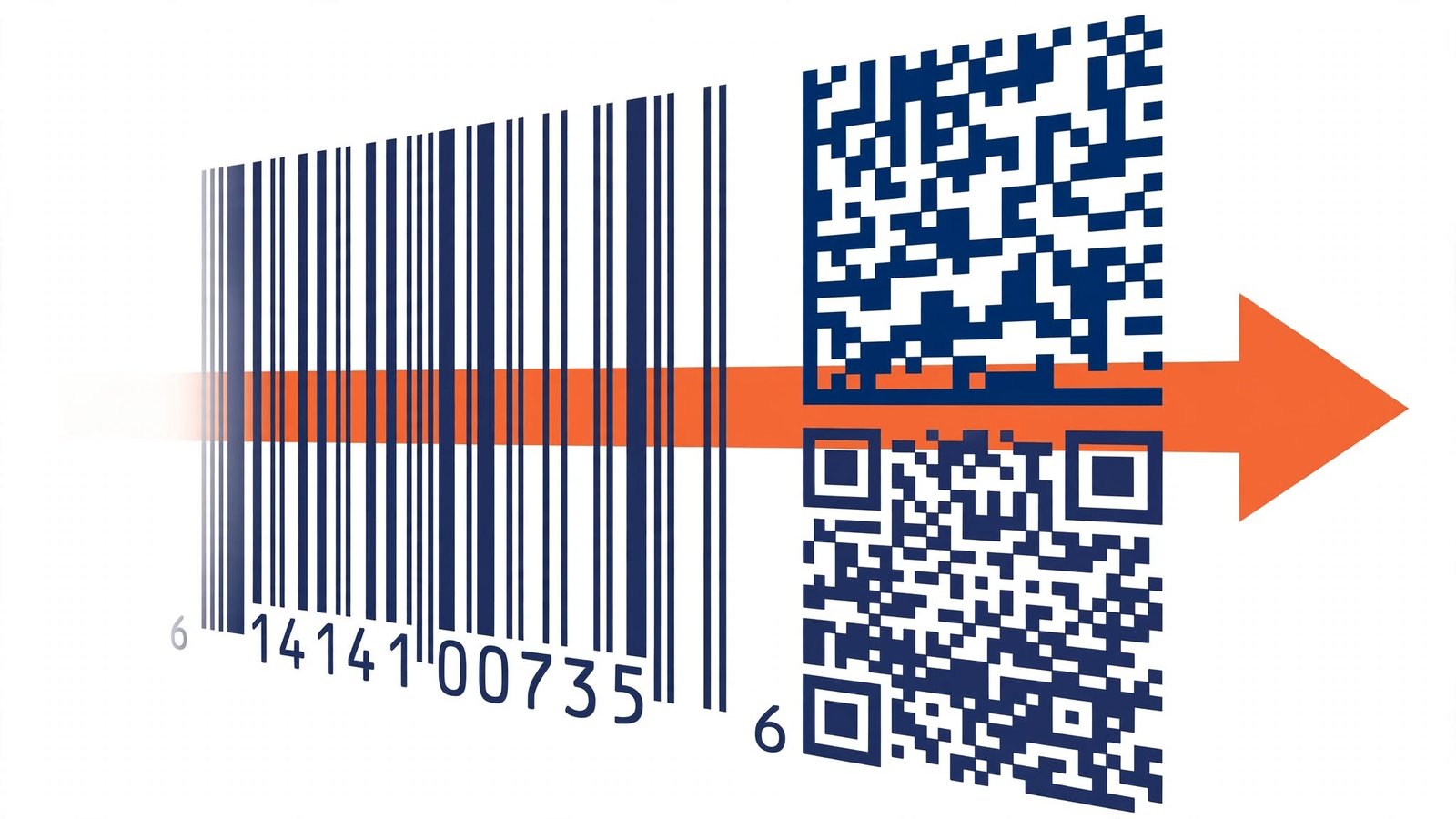
Traditional barcodes generally fall into two main categories: one-dimensional (1D) codes and two-dimensional (2D) codes. A 1D barcode, commonly found on grocery products and retail packaging, represents information through a sequence of bars and spaces. A 2D barcode, such as a QR code, uses a grid of visual elements to store more information within a relatively small area.
A 4D barcode introduces additional ways of representing information, although the extra dimension is not defined identically across all implementations. Some systems use time as an additional dimension, while others use combinations of color and shape to expand the available encoding options. This distinction matters because not every colorful barcode is a 4D barcode, and not every technology described as 4D uses an animated display.
The practical difference is that certain 4D designs can transmit information through a sequence of images or encode data using additional visual characteristics. However, this does not automatically make every 4D barcode faster, more secure, or more useful than a QR code. The right solution depends on the amount of information being transferred, the scanning environment, device compatibility, and the requirements of the application.
Key Features of 4D Barcode Technology
One notable feature of some 4D barcode systems is their ability to use multiple visual characteristics to represent information. Color, shape, spatial arrangement, and time-dependent changes can provide additional encoding possibilities beyond a basic pattern of black and white lines. When carefully designed, these methods can help communicate information efficiently without requiring a large printed label.
Another important feature is the potential to reuse the same display area for different data sequences. A conventional printed barcode generally remains unchanged unless the label is replaced, whereas a screen-based system can display different patterns at different times. This capability may be useful when information needs to be transmitted dynamically rather than permanently attached to an object.
Some implementations are also designed to work with ordinary camera-equipped devices, including smartphones. Nevertheless, compatibility depends on the particular encoding method, camera performance, display quality, lighting conditions, and decoding software. A standard QR code reader should not be assumed to support every 4D barcode format automatically.
Benefits of Using a 4D Barcode
One potential benefit of 4D barcode technology is increased flexibility in data representation. By incorporating additional visual properties or multiple frames, certain designs can communicate information that would otherwise require a different code format or several separate symbols. This can be helpful when a compact visual interface must support more than one data-transfer requirement.
Another advantage is the possibility of updating the information presented without reprinting a physical label. For instance, a digital display could show a sequence associated with a particular transaction, verification process, or data exchange. Since the content is generated electronically, the displayed sequence can change as the underlying application requires.
The technology may also support specialized identification and communication workflows. Where a suitable system is available, the ability to transmit data through visual sequences can provide an alternative to manually entering information or relying on a single static image. However, the benefits should be evaluated against practical considerations such as scanning reliability, implementation costs, processing requirements, and compatibility with existing equipment.
Retail and Digital Payments
In retail environments, barcode technology helps businesses identify products, manage inventory, and simplify transactions. A 4D barcode could potentially extend these capabilities in specialized digital systems by presenting changing information or supporting a sequence-based data exchange. For example, a compatible display could provide information associated with a particular transaction or verification process without requiring a permanently printed code for every interaction.
However, conventional barcodes and QR codes remain the more established choices for everyday retail operations. Any 4D barcode solution intended for checkout or payment processing would need appropriate software integration, reliable scanning, and security measures suited to the transaction.
Manufacturing and Supply Chain Management
Manufacturing businesses rely on identification systems to track components, monitor production stages, and maintain accurate records as products move through a facility. Barcodes are widely used for these purposes because they allow workers and automated systems to identify items quickly and consistently.
A suitable 4D barcode implementation could support specialized workflows in which information changes over time or multiple data sequences need to be communicated through a single display area. For example, a screen-based system could present different machine-readable patterns as an item progresses through defined stages of a process. Such a system would require appropriate software and tracking infrastructure; the barcode itself would not automatically record the item’s location or update its production history.
Healthcare and Medical Information
Healthcare organizations use barcodes to identify medical supplies, manage laboratory samples, track equipment, and support patient identification procedures. These applications depend on accurate scanning and reliable connections between the code and the relevant information system.
In specialized healthcare environments, a 4D barcode could offer an alternative method of transmitting changing information through a compatible digital display. Nevertheless, any use involving patient records, medication administration, or medical equipment would require rigorous validation, access controls, and dependable operation. Established barcode systems remain preferable when they already meet the application’s safety and operational requirements.
Digital Authentication and Information Sharing
Another possible application is digital authentication, where a visual code communicates information to a compatible reader. A time-based barcode sequence could make it possible to transmit changing data through a screen rather than relying exclusively on a fixed printed symbol.
This approach may be useful in controlled environments where applications need to exchange information through a camera. However, a changing barcode is not automatically secure. Strong authentication requires appropriate cryptographic protections, verification procedures, and safeguards against copying, replay, or unauthorized access.
4D Barcode vs. QR Code: Which Is Better?
Choosing between a 4D barcode and a QR code depends on what the application needs to accomplish. QR codes are widely supported, relatively easy to generate, and readable by many smartphones without specialized hardware. They are practical for website links, product information, digital tickets, menus, inventory identification, and numerous other everyday tasks.
A 4D barcode may offer advantages in specific applications that benefit from time-based sequences or additional visual encoding features. For example, a system that transmits information through multiple changing frames may communicate data differently from a single static QR code. This can be useful when the display itself is part of a controlled data-transfer process.
The trade-off is complexity. A 4D barcode may require dedicated decoding software, a compatible display, careful timing or image processing, and additional testing. QR codes generally offer broader compatibility and simpler deployment. For most ordinary business applications, a QR code or established barcode format is likely to be the more practical option unless a clearly defined requirement justifies a more specialized approach.
Challenges and Limitations of 4D Barcode Technology
Despite its potential, 4D barcode technology faces several practical challenges. One of the most important is scanning reliability. In systems that depend on changing visual patterns, poor lighting, screen flicker, motion blur, camera limitations, or incomplete frame capture can interfere with the decoding process. Color-based systems may also be affected by display characteristics, image compression, and differences in camera color reproduction.
Compatibility is another consideration. A barcode format is useful only when the receiving device has the necessary hardware and software to interpret it. Organizations that already use standard barcode scanners may need to introduce additional equipment or develop new applications before they can use a particular 4D barcode implementation.
Cost and complexity also matter. Designing, testing, deploying, and maintaining a specialized barcode system can require more resources than using established alternatives. Businesses must consider whether the additional functionality provides measurable value, rather than adopting the technology simply because it sounds more advanced.
Security and privacy should not be overlooked either. Encoding information in additional colors, shapes, or frames does not make that information inherently confidential. Sensitive data should be protected through appropriate encryption, access controls, and secure system design.
Is a 4D Barcode the Same as a 3D Barcode?
No. A 3D barcode and a 4D barcode are different concepts, although terminology can vary across technical applications. A 3D barcode can use physical depth as an additional encoding feature, allowing a scanner to interpret variations in the height or depth of a marked surface. Such codes may be engraved or otherwise applied to objects where conventional printed labels are unsuitable.
A 4D barcode, depending on its design, may use time-based sequences, color, shape, or other additional encoding characteristics. In a time-based approach, the information can change across successive displayed frames. In a color-and-shape approach, the additional visual properties help represent data within the code.
The important distinction is that these labels do not describe one universal standard with identical characteristics. Before selecting a solution, businesses should examine the specific encoding method, scanning requirements, supported devices, and intended application.
How to Choose the Right Barcode Technology
Selecting the right barcode starts with identifying the actual problem that needs to be solved. If the objective is to identify retail products, track warehouse inventory, or provide customers with quick access to a website, a conventional 1D barcode or QR code may already offer everything required.
If the application needs to communicate changing information through a digital display, transmit data through multiple visual frames, or use a specialized encoding method, a 4D barcode may be worth investigating. In that case, the decision should be based on demonstrated performance rather than theoretical advantages alone.
Businesses should also evaluate the available scanning hardware, integration requirements, data capacity, environmental conditions, and ongoing maintenance costs. A small-scale pilot can help establish whether the technology performs reliably under real operating conditions. Testing should include different devices, lighting conditions, scanning distances, and potential sources of interference.
Finally, consider the people who will use the system. A solution that offers additional technical capabilities but slows down employees or creates scanning errors may deliver less value than a simpler, established format. The best barcode technology is the one that meets the operational requirements reliably and cost-effectively.
The Future of 4D Barcode Technology
The future of 4D barcode technology will depend on whether its specialized capabilities solve problems that conventional identification systems cannot address as effectively. Research into time-based and multidimensional visual codes demonstrates different ways to encode and transfer information, particularly when digital displays and camera-based readers are available.
Potential developments include more efficient decoding algorithms, improved handling of imperfect images, better integration with mobile devices, and more reliable transmission of information through visual sequences. Such improvements could make specialized barcode systems more practical in environments where dynamic data exchange offers a clear advantage.
Even so, broader adoption is not guaranteed. Established barcode standards benefit from extensive device support, mature software ecosystems, and familiar workflows. Any emerging alternative must demonstrate meaningful improvements in reliability, usability, cost, or functionality to justify replacing or complementing those systems.
Frequently Asked Questions About 4D Barcodes
Can a 4D barcode be scanned with a smartphone?
Some 4D barcode implementations can be captured using a smartphone camera, particularly those designed to display visual patterns on a screen. However, the phone generally needs compatible decoding software, and an ordinary QR code scanner may not recognize the format.
Does a 4D barcode store more information than a QR code?
Some 4D barcode designs can use additional visual features or multiple frames to represent more information than a single static pattern. However, the actual capacity depends on the encoding method, the number of frames, scanning conditions, and decoding capabilities. It is not accurate to assume that every 4D barcode holds more data than every QR code.
Are 4D barcodes already widely used?
4D barcodes have been explored in technical research and specialized implementations, but they are not a universal replacement for conventional barcodes or QR codes. Their practical availability and adoption depend on the particular technology and application.
Can a 4D barcode change its information over time?
Yes, in systems that use time-dependent visual sequences, the displayed patterns can change to communicate different portions of information. This is different from a conventional printed barcode, which remains fixed unless the label is replaced.
Are 4D barcodes more secure than traditional barcodes?
Not inherently. Although some implementations can use changing patterns, security depends on how the system generates, validates, and protects the information. Encryption and suitable authentication mechanisms may still be necessary.
Is a 4D barcode better than a QR code for businesses?
Not necessarily. QR codes are usually more practical for common identification and information-sharing tasks because they are widely supported and easy to deploy. A 4D barcode is worth considering when its particular encoding capabilities address a specific business requirement.
Conclusion
A 4D barcode is a specialized approach to machine-readable information that can use additional visual characteristics or time-dependent patterns to encode and communicate data. Depending on the implementation, it may provide new possibilities for digital information exchange, compact data representation, and workflows that rely on changing visual content.
Its value, however, depends on the problem being solved. Conventional barcodes and QR codes remain reliable choices for many everyday applications, while 4D barcode systems may be useful in more specialized environments that require additional functionality.
For businesses considering this technology, the most sensible approach is to understand the specific 4D barcode format, test its performance, and compare its practical benefits with the cost and complexity of established alternatives. That way, the decision is guided by real operational needs rather than the appeal of a newer technology.
