



The phrase “Pravi Celer” may look like the name of a special vegetable, an unusual cultivar, or even a recently discovered health food. In reality, the meaning is much simpler and more useful to understand.
“Pravi” can be translated as “true,” “real,” or “genuine,” while “celer” means celery. In South Slavic usage, the phrase is associated with genuine or cultivated celery, botanically connected with the species Apium graveolens.
That distinction matters because celery has several cultivated forms, and its name can sometimes be confused with related plants or with products made using celery seeds, leaves, roots, or flavorings.
Understanding Pravi Celer therefore starts not with claims about a mysterious new food, but with the plant itself. It is a story about language, botany, agriculture, traditional food culture, and the many ways one species can be used.
What Does Pravi Celer Actually Mean?
At its simplest, Pravi Celer means “true celery” or “real celery.” The expression should generally be understood as a descriptive name rather than as the official name of a separate species.
The celery associated with the term belongs to Apium graveolens, a plant in the Apiaceae family. This is the same broader species from which several familiar celery forms have been developed.
Consequently, seeing the words Pravi Celer does not automatically mean that the product is a rare variety or a nutritionally superior form of celery.
Instead, the important question is which form of Apium graveolens is being discussed and which part of the plant is intended for use.
The Botanical Meaning Behind the Name
Botanical classification provides a clearer way to understand Pravi Celer.
Apium graveolens is an herbaceous plant with the characteristic aromatic smell associated with celery. The species has a long history in cultivation and occurs in both wild and cultivated forms.
Modern agriculture has produced different types of Apium graveolens by selecting plants for particular characteristics.
Some are valued for their long, crisp stalks. Others are cultivated for their enlarged edible underground portion, while another group is grown mainly for its strongly flavored leaves.
This is why celery can appear in several very different forms while still having a common botanical identity.
Is Pravi Celer a New Variety?
No reliable botanical distinction supports treating Pravi Celer as a newly discovered celery species.
The expression itself does not establish a unique cultivar, a special genetic line, or a separate vegetable species. Claims that “true celery” is automatically a new or superior form should therefore be approached carefully.
A specific cultivar can certainly have differences in size, flavor, color, texture, growing requirements, or resistance to particular diseases. But those differences require an identifiable cultivar or variety name rather than the phrase Pravi Celer alone.
This is an important distinction for anyone researching the subject online.
Pravi Celer and Ordinary Celery

For most practical purposes, the celery sold in grocery stores is closely connected to what people mean when they talk about true or genuine celery.
The familiar stalk celery has long, thickened leaf stalks that are usually eaten raw or cooked. Its crisp texture and distinctive aroma make it useful in both everyday meals and more elaborate recipes.
The plant is not generally consumed only for nutrition. Its flavor is one of its most important qualities.
Even a relatively small amount of celery can contribute a recognizable aromatic character to soups, sauces, stews, salads, stocks, and vegetable dishes.
The Difference Between Wild and Cultivated Celery
The word “true” becomes more interesting when celery is considered from a historical perspective.
Wild celery and cultivated celery are related, but the wild plant can be considerably more intense in flavor and less suitable for eating as the large, crisp vegetable familiar to modern consumers.
Cultivation changed this relationship.
Over generations, farmers selected plants with desirable characteristics, gradually producing forms that were more useful as vegetables. Selection favored features such as larger edible portions, improved tenderness, more manageable flavor, and better performance under cultivation.
Modern celery is therefore the product of a long process of domestication and agricultural selection.
The Mediterranean Connection
Celery has strong historical associations with the Mediterranean region.
The species occurs naturally in parts of Europe and surrounding areas, particularly in habitats where adequate moisture is available. Its wild relatives and forms have been associated with wet environments, coastal areas, and other suitable habitats.
The Mediterranean connection is significant because the region has played an enormous role in the development of many familiar culinary plants.
Celery eventually moved far beyond its original geographic associations and became an internationally cultivated crop.
Today, it is grown and consumed in numerous countries, demonstrating how a regional plant can become part of global food culture.
The Three Major Cultivated Forms
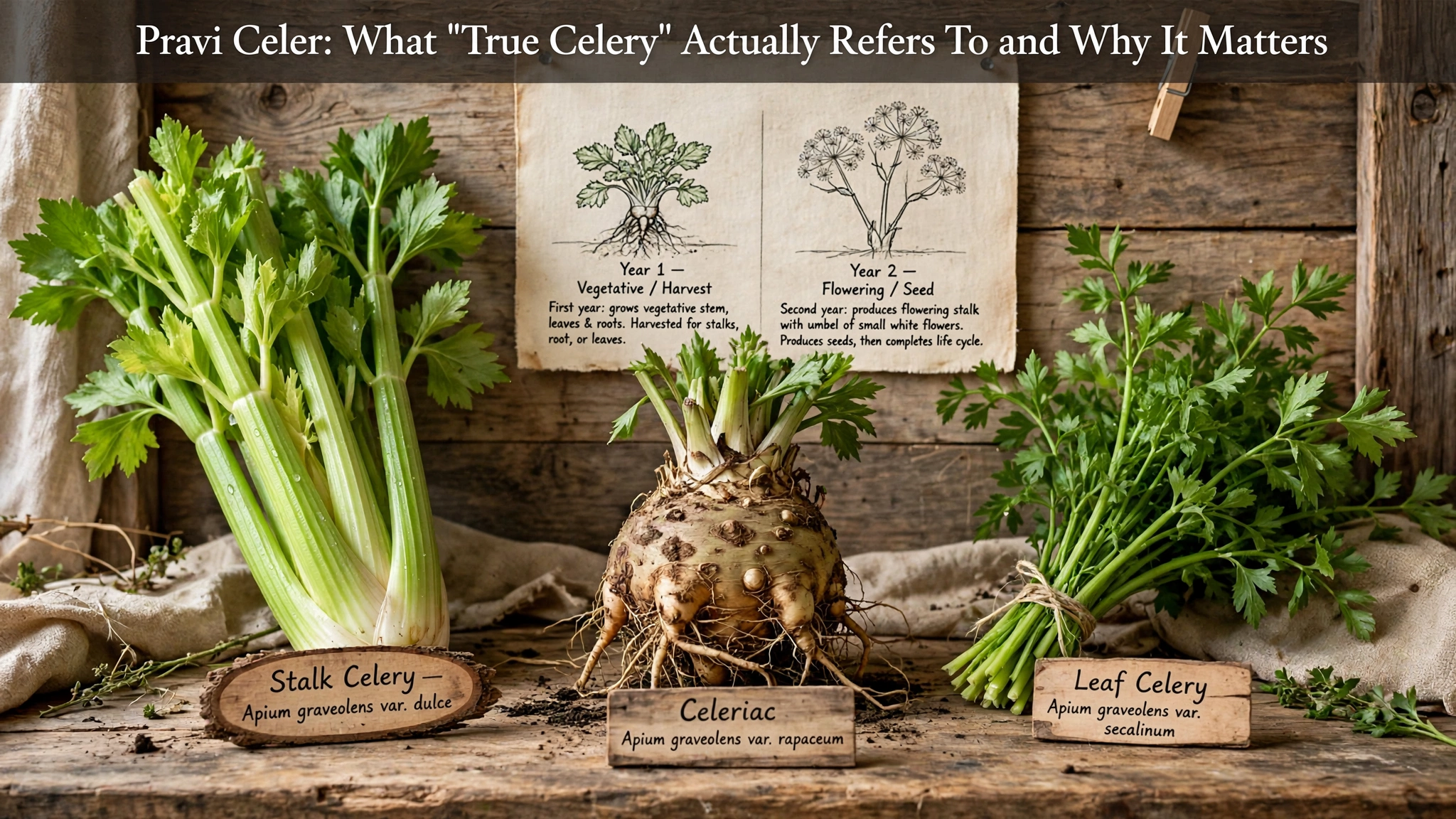
One of the most interesting aspects of Apium graveolens is that it includes different cultivated forms developed for different purposes.
The best-known is stalk celery, which is cultivated for its thick, crisp leaf stalks. This is the form most people picture when they hear the word “celery.”
Another form is celeriac, sometimes called celery root. It develops a large, swollen underground portion that is harvested as a vegetable.
The third major form is leaf celery, sometimes known as smallage. Instead of emphasizing large stalks or a swollen root, this form is valued primarily for its aromatic foliage.
These forms can look remarkably different, yet they share the same underlying species identity.
Why Celeriac Can Cause Confusion
Celeriac is particularly important when discussing what constitutes “real” celery.
At first glance, celeriac may not look much like conventional celery. It has a rough, knobby appearance and is usually sold without the long green stalks associated with supermarket celery.
Inside, however, it has a pale, firm flesh with a characteristic celery-like flavor.
Celeriac is not an unrelated vegetable pretending to be celery. It is a cultivated form of Apium graveolens selected for its enlarged edible underground structure.
This means that “true celery” should not be interpreted so narrowly that celeriac is considered somehow inauthentic.
Leaf Celery and Its Culinary Role
Leaf celery offers another example of how diverse the celery plant can be.
This type is grown primarily for its leaves and aromatic qualities rather than the thick stalks that characterize conventional celery.
Its stronger flavor can make it particularly useful in cooking where a concentrated celery aroma is desired.
Leaves from conventional celery can also be used in cooking. They are often more intensely flavored than the stalks and can be added to soups, stocks, sauces, salads, and other dishes.
What Makes Celery Taste Like Celery?
The characteristic flavor of celery comes from naturally occurring aromatic compounds in the plant.
These compounds give celery its distinctive smell and contribute to the savory, slightly herbal quality that makes it recognizable even when used in small quantities.
This explains why celery has an important role in cooking despite not always being the main ingredient.
Its contribution is often subtle.
A few chopped stalks can help create a deeper background flavor in a soup or stew, while fresh celery can provide a crisp contrast in a salad or raw vegetable dish.
Pravi Celer in Traditional Cooking
Celery has long been used as both a vegetable and an aromatic ingredient.
In many cuisines, it is chopped and combined with other vegetables before cooking. This allows its flavor to blend into the dish rather than dominating it.
Celery can also be served raw, where its crisp texture becomes one of its main attractions.
It works particularly well with dips, salads, sandwiches, soups, casseroles, sauces, and cooked vegetable dishes.
The versatility of celery helps explain why it has remained relevant despite its relatively ordinary appearance.
Why Celery Is More Than a Salad Ingredient
It is easy to think of celery primarily as something added to salads or eaten with dips.
Its culinary importance, however, is much broader.
Celery can serve as an aromatic base for cooked foods, contribute texture to cold dishes, and add flavor to broths and stocks. The leaves can be used separately, while celery seeds have also been used as a spice and flavoring ingredient.
This makes the plant unusually versatile.
Different parts of the same species can play different culinary roles, from crunchy vegetable to aromatic herb and flavorful seed.
The Nutritional Side of Pravi Celer
Celery is a relatively low-calorie vegetable with a high water content.
It provides dietary fiber along with nutrients such as vitamin K and smaller amounts of other vitamins and minerals. Its nutritional contribution is best considered as part of a varied diet rather than as a standalone health solution.
The value of celery is partly its accessibility.
It can be added to meals without dramatically increasing their calorie content, while contributing texture, flavor, water, and useful nutrients.
For people trying to eat more vegetables, this makes celery a practical addition to an overall healthy eating pattern.
Does Celery Have Special Health Benefits?
Celery contains a variety of naturally occurring plant compounds, which is one reason it has attracted attention from nutrition researchers and wellness communities.
However, there is an important difference between saying that a vegetable contains potentially useful compounds and claiming that it can prevent or cure diseases.
Celery should not be treated as a miracle food.
A balanced diet containing a wide variety of vegetables, fruits, whole grains, legumes, nuts, seeds, and other nutritious foods provides a much broader nutritional foundation than depending on one ingredient.
The strongest case for celery is therefore straightforward: it is a nutritious vegetable that can contribute to a healthy diet.
Pravi Celer and the Celery Juice Trend
Celery juice has become particularly popular in modern wellness culture.
Its popularity has led to claims that drinking celery juice can “detox” the body or produce dramatic health improvements. Such claims often go considerably further than established nutritional evidence.
Celery juice does provide fluid and celery-derived compounds, but juicing also changes the physical structure of the food and removes much of the fiber found in whole celery.
Eating the whole vegetable therefore offers a different nutritional experience.
For most people, there is little reason to think of celery juice as a magical upgrade over ordinary celery.
Why Whole Celery Still Matters
Whole celery has advantages that are easy to overlook.
Its stalks provide crunch and dietary fiber, while its leaves add additional flavor. It can be eaten raw or incorporated into cooked meals, making it easy to include in different eating patterns.
Whole vegetables also encourage a more varied approach to food.
Instead of concentrating on one drink or ingredient, people can use celery alongside carrots, onions, leafy greens, legumes, tomatoes, peppers, and other foods.
That broader approach is generally more useful than searching for one ingredient that supposedly provides all the answers.
How to Recognize Fresh Celery
Fresh celery is generally firm, crisp, and hydrated.
The stalks should not be excessively limp, shriveled, or slimy. Fresh leaves should retain their natural green appearance rather than looking severely wilted or discolored.
Color can vary depending on the variety and growing conditions, so appearance alone does not determine quality.
Texture is often one of the most useful indicators. A crisp stalk is usually a sign that the vegetable has retained much of its moisture.
How Pravi Celer Is Grown
Celery can be more demanding to grow than some other garden vegetables.
It generally performs best when supplied with adequate moisture and suitable growing conditions. The plant prefers fertile soil and consistent access to water, while extreme environmental conditions can interfere with development.
Commercial growers manage factors such as irrigation, soil fertility, temperature, pest pressure, and disease.
Gardeners can also grow celery successfully when they provide appropriate conditions and sufficient patience.
Celery’s Role in Modern Agriculture
Celery is now an established commercial crop rather than an obscure traditional plant.
Its cultivation has involved generations of breeding and selection aimed at producing plants that meet consumer and agricultural needs.
Breeders have worked on characteristics including stalk quality, flavor, productivity, disease resistance, and suitability for different climates.
The history of celery therefore illustrates an important principle of agriculture: the vegetables people eat today are often very different from the wild plants from which they originated.
Why the Name Matters
The phrase Pravi Celer matters because language can influence how people understand food.
A foreign-language term can sometimes appear mysterious when it is actually a straightforward description.
That is exactly what happens when “pravi celer” is presented as though it automatically identifies a rare or revolutionary food.
Understanding the translation removes much of the mystery.
Instead of asking whether Pravi Celer is a secret superfood, the more useful questions are: Which celery form does the term refer to? Is it stalk celery, leaf celery, or celeriac? How was it grown? How is it being used? And what nutritional qualities does the particular form provide?
Common Misunderstandings About Pravi Celer
One common misunderstanding is that Pravi Celer must be a separate species.
It is better understood as a phrase associated with genuine celery, with the botanical identity centered on Apium graveolens.
Another misconception is that “true” automatically means superior.
The word describes authenticity or identity; it does not by itself prove that one celery form contains more nutrients, tastes better, lasts longer, or provides extraordinary health benefits.
A third misunderstanding is that all celery must look identical.
As the existence of stalk celery, leaf celery, and celeriac demonstrates, one species can contain cultivated forms with very different appearances and uses.
Pravi Celer and Food Terminology
The story of Pravi Celer demonstrates why common names should sometimes be treated carefully.
A food name can carry cultural, geographic, and linguistic information that is not obvious from an English translation.
At the same time, common names do not always provide the precision needed for scientific identification.
When accuracy matters, the scientific name Apium graveolens offers a clearer reference point. From there, the particular cultivated form can be identified according to whether it is grown for stalks, leaves, roots, or other usable parts.
Why the Distinction Is Useful for Consumers
For shoppers, understanding the term can prevent unnecessary confusion.
If a product is marketed as Pravi Celer, consumers do not need to assume that they have discovered a completely different vegetable.
Instead, they can look at the actual product and determine whether it is stalk celery, celeriac, leaf celery, celery seed, or another celery-derived ingredient.
This is a much more practical way to evaluate food.
It also makes it easier to compare products based on freshness, cultivation, preparation, nutritional information, and intended culinary use rather than relying on an unfamiliar name.
Why the Distinction Is Useful for Gardeners
Gardeners can benefit from the same clarification.
Planting celery requires knowing what type is being grown because different forms have different characteristics and harvest goals.
Someone looking for crunchy stalks needs a stalk-celery type, while someone interested in celery root needs a celeriac type.
A gardener interested in aromatic leaves may prefer a leaf-celery type.
The phrase “true celery” alone does not provide enough information to select the right plant for a particular garden.
Why the Distinction Is Useful for Cooks
For cooks, the differences can be even more practical.
Stalk celery provides crunch and a mild aromatic flavor. Leaf celery can deliver a more concentrated herbal note, while celeriac brings a dense texture and earthy celery flavor to cooked dishes.
Knowing these distinctions allows cooks to select the right form for the desired result.
It also encourages greater use of the entire plant rather than treating celery as nothing more than a bag of stalks.
The Real Significance of Pravi Celer
The real significance of Pravi Celer is not that it represents a secret vegetable unknown to the rest of the world.
Its significance lies in what the phrase reveals about celery itself.
Behind the familiar supermarket stalk is a plant with a long history, several cultivated forms, a distinctive botanical identity, and a wide range of culinary uses.
The term also reminds us that food names can lose their meaning when translated or removed from their original cultural context.
Final Thoughts
Pravi Celer is best understood as “true celery” or “real celery,” associated with the genuine celery plant, Apium graveolens. It should not automatically be treated as the name of a newly discovered species, miracle food, or superior celery cultivar.
The species behind the name is much more interesting than exaggerated claims suggest.
It includes different cultivated forms, from familiar stalk celery to celeriac and leaf celery, each developed for a particular part of the plant and a particular culinary purpose.
Its history stretches from wild celery and traditional uses to modern agriculture, commercial cultivation, nutrition, and contemporary cooking.
Understanding Pravi Celer therefore means understanding the real plant behind the name. Once the terminology is clear, the subject becomes much less mysterious and much more fascinating: it is the story of how one ancient plant became several useful foods while remaining part of the same botanical family.
Ultimately, the value of Pravi Celer does not depend on calling it extraordinary.
Its genuine importance comes from its history, versatility, nutritional contribution, agricultural significance, and continuing place in kitchens around the world.
This version is now complete and substantially more developed, with the article focused on the actual meaning of the term rather than treating “Pravi Celer” as a fictional new celery variety.
