



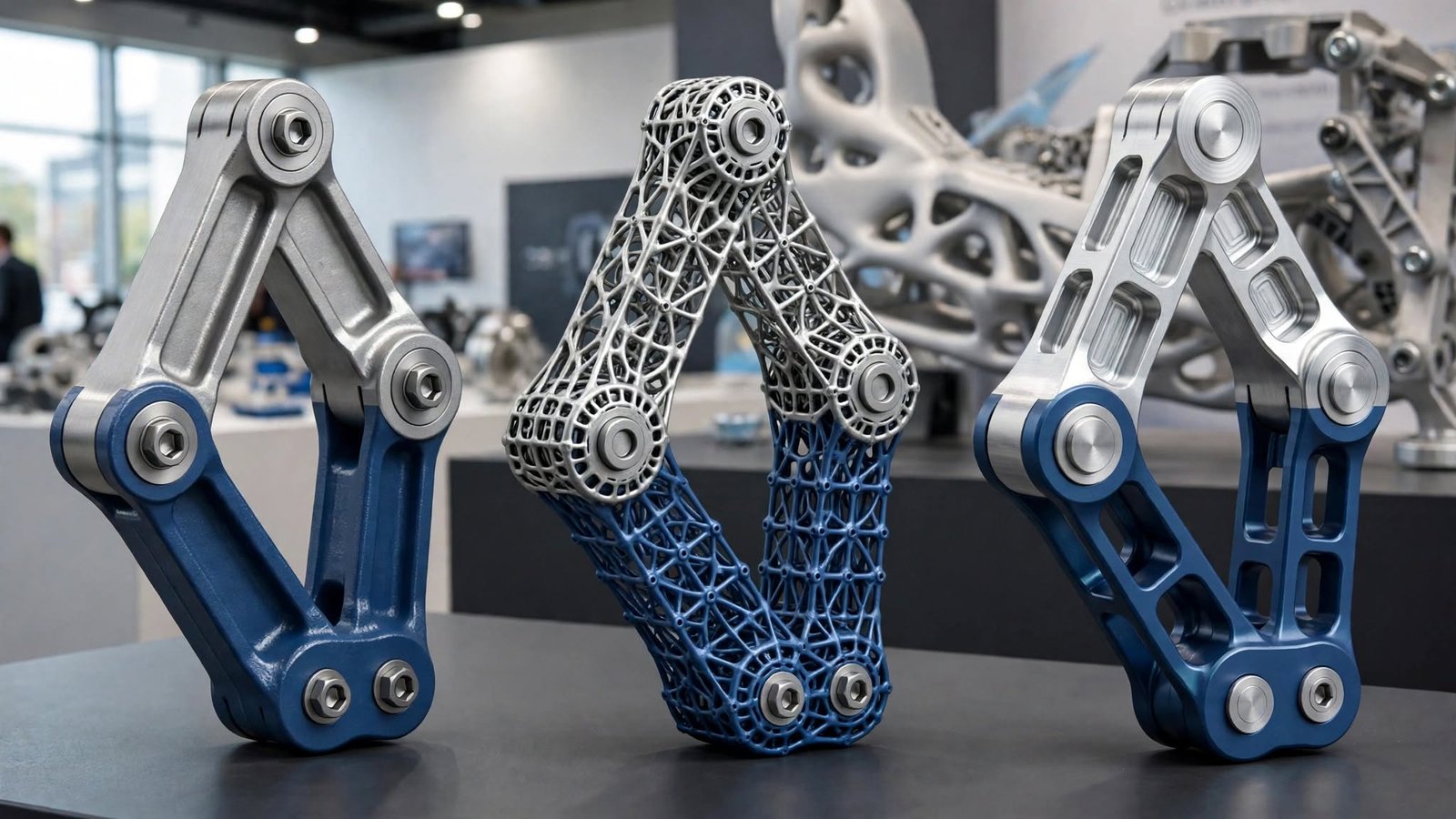
Product design and manufacturing are changing rapidly as engineers look for better ways to develop products that are lighter, stronger, more efficient, and less expensive to produce. Traditional design methods still play an important role in engineering, but they can take considerable time when a project requires multiple design changes, performance improvements, and detailed testing.
This is where generative design software comes in.
Generative design allows engineers to explore different design possibilities by setting specific requirements, such as material type, weight limits, strength, available space, and manufacturing methods. Instead of creating every design manually, engineers can use software to generate and compare several alternatives before deciding which one is best suited to the project.
The technology is becoming increasingly useful in industries such as automotive manufacturing, aerospace, industrial machinery, consumer products, and medical equipment. It can help engineers rethink how components are designed, identify opportunities to reduce material usage, and develop shapes that might be difficult to create using conventional design methods.
However, choosing the right software is not always straightforward. Different applications offer different capabilities, and the best option depends on the type of product, the manufacturing process, the engineering team’s experience, and the available budget.
In this article, we will explore some of the leading generative design software applications, explain how they are used in product development and manufacturing, and discuss what businesses should consider before adopting this technology.
What Is Generative Design Software?
Generative design software is a computer-based engineering tool that helps designers develop and evaluate multiple possible solutions to a design problem.
The process usually begins with a set of requirements. An engineer defines what the product needs to do, how much force it must withstand, what material can be used, how much space is available, and how the finished component will be manufactured.
The software then uses computational algorithms, optimization methods, and, in some applications, artificial intelligence to explore possible designs that meet those requirements.
For example, imagine an engineer designing a mounting bracket for an industrial machine. The bracket needs to support a particular load while remaining lightweight and fitting within a limited space. Rather than repeatedly adjusting the shape by hand, the engineer can define the necessary conditions and use generative design software to explore alternative structures.
The resulting designs can then be reviewed, tested, and refined before one is selected for production.
It is important to understand that generative design does not eliminate the need for engineering knowledge. The quality of the results depends heavily on the requirements entered into the software and the engineer’s ability to evaluate the proposed solutions.
Best Generative Design Software for Product Development and Manufacturing
Several software platforms support generative design, topology optimization, or related engineering workflows. Each has its own strengths, so it is more useful to compare them according to their practical applications than to declare one the best for every situation.
1. Autodesk Fusion
Autodesk Fusion is a popular option for teams that want to bring product design, simulation, and manufacturing activities together in one environment.
Its generative design capabilities allow engineers to explore different component geometries based on factors such as loads, materials, design constraints, and manufacturing requirements. The platform also supports CAD and CAM workflows, which can make the transition from design to production more convenient.
For example, a small manufacturing company developing a mechanical bracket could use Fusion to investigate alternative designs, compare their structural performance, and prepare a suitable model for machining or prototyping.
Main applications:
- Mechanical components and mounting brackets
- Product prototyping and development
- CNC machining projects
- Lightweight parts for robotics and automotive applications
Why consider it?
Fusion is particularly attractive to small and medium-sized businesses because it brings several engineering tasks into a connected workflow. However, access to specific generative design features depends on the subscription and product package.
2. Siemens NX
Siemens NX is designed for advanced product engineering and is commonly associated with complex industrial design and manufacturing workflows.
It supports sophisticated CAD operations and engineering optimization within a broader product development environment. This makes it relevant for companies working with complex assemblies, demanding mechanical requirements, and established manufacturing systems.
In aerospace engineering, automotive manufacturing, and industrial machinery, engineers often need to balance weight, strength, durability, and production requirements. NX can support this process by helping teams investigate design alternatives while maintaining connections with their wider engineering workflows.
Main applications:
- Aerospace and automotive components
- Industrial machinery
- Complex mechanical assemblies
- Large-scale product engineering and manufacturing
Why consider it?
NX is worth evaluating for organizations that need advanced engineering capabilities and close integration between design and manufacturing. Its implementation and licensing costs, however, may be significant for smaller businesses.
3. PTC Creo
PTC Creo is widely used for parametric 3D modeling and mechanical product development. Depending on the available modules and licensing, it also supports topology optimization and generative design workflows.
One of its main advantages is its relationship with parametric engineering. Designers can work with defined dimensions, features, and relationships while exploring opportunities to improve component performance.
For instance, a manufacturer developing an industrial machine may need to reduce the weight of an existing support component without changing its mounting locations. Creo can form part of a workflow for evaluating an optimized design and incorporating the selected geometry into the product model.
Main applications:
- Industrial equipment
- Automotive components
- Mechanical product development
- Redesigning existing parts to reduce weight or improve performance
Why consider it?
Creo is a strong option for engineering teams that already use parametric CAD and want to incorporate optimization into their established design process. The exact capabilities available depend on the selected software package.
4. nTop
nTop, formerly known as nTopology, focuses on advanced computational engineering and complex geometry.
It is particularly useful when engineers need to create structures that are difficult to manage using conventional CAD methods. These include lattice structures, intricate internal channels, and components with geometry that changes according to specific engineering requirements.
One example is a lightweight metal component designed for additive manufacturing. The engineer may want to control the internal structure to achieve a particular balance between weight, stiffness, and material use. nTop provides tools for developing and managing these complex designs.
Main applications:
- Metal additive manufacturing
- Lattice structures
- Lightweight aerospace components
- Advanced thermal management systems
- Specialized industrial and medical products
Why consider it?
nTop is particularly valuable when complex geometry is a central part of the engineering challenge. It is a specialized design tool, however, rather than a complete replacement for every conventional CAD or manufacturing application.
5. Siemens Simcenter Inspire
Simcenter Inspire focuses on simulation-driven design and engineering optimization.
It helps engineers investigate how components behave under different physical conditions and explore ways to improve structural performance. This is especially useful during the early stages of product development, when a design can still be changed without affecting a large amount of completed engineering work.
For example, an engineer designing a load-bearing bracket could use simulation and optimization methods to identify areas where material may be unnecessary while maintaining the required structural performance.
Main applications:
- Structural components
- Lightweight industrial equipment
- Mechanical brackets and supports
- Early-stage product development
- Simulation-driven design improvements
Why consider it?
Simcenter Inspire is worth considering for teams that want to connect design exploration with engineering simulation. Before selecting it, businesses should confirm that the available modules support their particular optimization and manufacturing requirements.
6. SOLIDWORKS
SOLIDWORKS is a widely used mechanical CAD platform for creating parts, assemblies, engineering drawings, and product models.
Its simulation offerings include topology optimization capabilities in applicable packages. These tools can help engineers investigate ways to reduce material while meeting specified structural requirements.
For a manufacturer that already uses SOLIDWORKS, introducing optimization into the existing workflow may be more practical than replacing the entire design system.
For example, an engineer could review an existing machine component, define its loading conditions, and investigate whether the original design uses more material than necessary.
Main applications:
- Mechanical parts and assemblies
- Consumer products
- Industrial machinery
- Component redesign
- Structural optimization
Why consider it?
SOLIDWORKS is worth considering for teams that want to build on an established mechanical design workflow. However, it is important to distinguish its topology optimization capabilities from the broader generative design functions available in some other platforms.
7. Ansys Discovery
Ansys Discovery is an engineering design and simulation application that helps users investigate physical behavior while developing product concepts.
It supports interactive simulation workflows, allowing engineers to explore how changes in geometry may affect performance. Depending on the application, this can include structural, thermal, and fluid-related investigations.
For example, a company developing an electronic enclosure may need to understand how heat moves through the design and whether changes to the geometry could improve cooling performance.
Main applications:
- Thermal management
- Structural design evaluation
- Fluid-related engineering problems
- Product concept development
- Simulation-led design exploration
Why consider it?
Ansys Discovery is particularly relevant when understanding physical performance is central to the design process. Engineers should verify the available optimization features rather than assuming that every simulation capability includes full generative design functionality.
Quick Comparison of Generative Design Software
Choosing software becomes easier when the main requirements are clear.
| Software | Main strength | Suitable for |
|---|---|---|
| Autodesk Fusion | Connected design and manufacturing workflow | Small and medium-sized engineering teams |
| Siemens NX | Advanced product engineering | Large industrial organizations |
| PTC Creo | Parametric product development | Established mechanical design teams |
| nTop | Complex geometry and lattice structures | Additive manufacturing specialists |
| Simcenter Inspire | Simulation-driven optimization | Structural engineering teams |
| SOLIDWORKS | Mechanical CAD and optimization | Conventional product design teams |
| Ansys Discovery | Interactive engineering simulation | Simulation-focused development teams |
These are general recommendations rather than a universal ranking. Actual capabilities depend on the software version, licensing package, and specific engineering requirements.
Major Applications of Generative Design in Product Development
Generative design can be useful in many industries, but its value becomes especially clear when a product must meet several demanding requirements at the same time.
1. Lightweight Product Design
Reducing weight is a major priority in industries such as aerospace, automotive manufacturing, robotics, and portable equipment.
A lighter component may improve energy efficiency, reduce material requirements, or make a product easier to handle. However, reducing weight without considering strength and durability can create serious engineering problems.
Generative design helps engineers explore alternative ways to distribute material throughout a component. Instead of removing material randomly, the process uses defined performance requirements to investigate which areas contribute most to the product’s function.
For example, a mounting bracket used in a robotic arm may need to withstand repeated loads while keeping its mass as low as possible. Generative design can help identify candidate structures that meet the required stiffness and strength targets.
The final design still needs to be checked for fatigue, vibration, deformation, and other relevant operating conditions.
2. Additive Manufacturing and 3D Printing
Generative design and 3D printing work well together because additive manufacturing can produce shapes that would be difficult to create using conventional machining.
These designs may include internal channels, branching structures, lattice patterns, and integrated components.
For example, a heat exchanger can be designed with complex internal passages to support heat transfer, while a structural component may use a carefully designed lattice to reduce weight.
This freedom creates new opportunities, but it also introduces challenges. Engineers must consider print orientation, support structures, minimum feature sizes, surface finish, residual stresses, and post-processing requirements.
A design that looks excellent in a simulation may still be expensive or difficult to manufacture. The best results come from considering the printing process from the beginning rather than treating it as a final production step.
3. Automotive Engineering and Electric Vehicles
Automotive manufacturers continually look for ways to improve performance while controlling production costs.
Weight reduction is particularly important for electric vehicles, where vehicle mass can influence energy consumption and driving range. Generative design can help engineers investigate lighter brackets, structural supports, motor mounts, and selected battery-related components.
It may also support part consolidation, where several separate components are redesigned as one integrated part. In suitable applications, this can reduce fasteners, assembly operations, and inventory requirements.
However, automotive components must satisfy demanding safety and durability requirements. Crashworthiness, fatigue, vibration, temperature changes, and manufacturing consistency must all be considered before a design is approved.
4. Consumer Products and Industrial Equipment
Generative design is not limited to aerospace or other high-tech industries.
Manufacturers of power tools, household appliances, electronics, sporting equipment, and industrial machinery can use optimization to improve selected components.
Consider a handheld power tool. Its internal structure must support the motor, battery, switches, and other parts while providing enough space for cooling and assembly.
An engineer could use optimization to investigate a lighter internal support structure without changing the product’s overall shape or the way the user holds it.
This approach can improve structural efficiency while preserving the features that matter most to customers.
5. Medical Devices and Customized Products
Generative design and related computational methods also have applications in medical engineering.
They can help develop customized prosthetic components, orthopedic implants, surgical instruments, and assistive devices. Depending on the application, engineers may explore porous structures, complex geometry, or designs adapted to individual anatomical requirements.
For example, a customized implant may require a particular shape and carefully controlled mechanical properties. Computational modeling can help engineers investigate suitable design alternatives.
Medical applications require strict validation. Biocompatibility, sterilization, fatigue resistance, manufacturing quality, and regulatory requirements must all be addressed. A design generated by software is not automatically safe for clinical use.
How Generative Design Improves Manufacturing Efficiency
The main benefit of generative design is not simply that it produces unusual shapes. Its real value lies in helping engineers make better decisions about material, performance, and production.
Reduced material consumption
A well-optimized design may use less material while maintaining the required performance. This can reduce raw material costs and, in some cases, the amount of waste produced during machining.
The actual savings depend on the material, manufacturing method, and original design.
Fewer components and simpler assemblies
In suitable applications, generative design can help engineers combine multiple components into one integrated structure.
This may reduce the number of fasteners, simplify assembly, and make inventory management easier. However, engineers must also consider repairability, inspection, and replacement costs.
Better product performance
Design alternatives can be compared against measurable objectives such as stiffness, displacement, stress, weight, and thermal behavior.
This allows engineers to evaluate different solutions systematically instead of relying entirely on experience or visual judgment.
Faster design exploration
Generating and comparing multiple alternatives can reduce the amount of manual work required during early product development.
However, time savings are not guaranteed. Complex studies may require considerable setup, computing time, design review, and validation.
Opportunities for more sustainable manufacturing
Using less material and reducing unnecessary manufacturing operations can improve resource efficiency.
Nevertheless, sustainability should be assessed across the product’s life cycle. Material production, manufacturing energy, post-processing, product durability, repair, and recycling can all influence the final environmental impact.
Generative Design for Different Manufacturing Processes
The manufacturing process plays an important role in determining whether a generated design is practical.
CNC machining: Optimization can reduce unnecessary material, but the design must allow suitable tool access and account for cutting tools, fixtures, and machining setups.
Metal casting: Engineers must consider draft angles, wall thickness, parting lines, and the use of cores. A complex optimized shape may not be suitable for casting without additional changes.
Metal 3D printing: Additive manufacturing supports complex internal structures, but print orientation, supports, surface quality, and post-processing can affect cost and performance.
Injection molding: Components must satisfy requirements relating to wall thickness, draft, mold design, and material flow. Optimized geometry still needs to be compatible with the molding process.
Sheet metal fabrication: Designs must account for bending limits, bend radii, forming operations, and joining methods.
Composite manufacturing: Engineers must consider fiber orientation, material layup, delamination risks, and the limitations of the chosen production method.
The key lesson is simple: the best design is not necessarily the one with the most complex geometry. It is the one that meets its performance requirements and can be manufactured reliably at an acceptable cost.
Generative Design vs. Traditional CAD and Topology Optimization
These terms are often used together, but they describe different approaches to engineering design.
Traditional CAD gives engineers direct control over dimensions, sketches, features, and geometry. It is essential for developing detailed product models and manufacturing documentation.
Topology optimization focuses on finding an efficient distribution of material within a defined design space. It is often used to reduce weight while maintaining structural performance.
Generative design can explore multiple alternative solutions based on engineering requirements, constraints, and manufacturing considerations. Depending on the software, it may incorporate topology optimization, simulation, automated geometry generation, and other computational methods.
The approaches can complement one another. A designer may use generative design to explore alternatives, select a promising candidate, and then refine the chosen model using traditional CAD tools.
None of these methods removes the need for engineering judgment or validation.
Limitations and Challenges of Generative Design Software
Although generative design offers several advantages, it is important to understand its limitations before investing in new software.
Learning and implementation costs
Advanced engineering tools can require training, additional licenses, computing resources, and changes to established workflows. Businesses should evaluate the overall cost rather than looking only at the software subscription.
Difficulty editing generated geometry
Some optimized shapes are difficult to modify using conventional parametric CAD methods. Converting the geometry into a practical engineering model, preparing drawings, and maintaining revisions may require additional work.
Dependence on accurate inputs
The software relies on the requirements and assumptions supplied by the engineer. Incorrect loads, unrealistic boundary conditions, or incomplete material information can lead to unsuitable results.
Manufacturing challenges
A design may perform well in a simulation but prove difficult or expensive to manufacture. Complex geometry can also make inspection, cleaning, maintenance, and repairs more challenging.
Verification and safety
Engineers must verify that the final design meets applicable safety standards and performance requirements. Depending on the product, this may involve additional simulation, physical testing, fatigue analysis, and regulatory review.
Integration with existing systems
Before adopting a new platform, businesses should consider how it will work with existing CAD, simulation, product data management, and manufacturing systems. Maintaining reliable design records and revision control is important throughout product development.
How to Choose the Best Generative Design Software
The best way to choose software is to begin with a real engineering problem.
First, define what you want to improve. This could be component weight, structural strength, manufacturing cost, thermal performance, or assembly complexity.
Next, identify how the component will be produced. A design intended for CNC machining has different requirements from one intended for metal 3D printing.
It is also important to check whether the software works with your existing CAD models, simulation tools, and manufacturing processes. A technically powerful platform may not be the best choice if it creates unnecessary problems for the engineering team.
Cost should be evaluated carefully. Licensing, training, implementation, computing resources, engineering time, and validation can all affect the return on investment.
Finally, test the software on a representative component before committing to a large-scale implementation. Compare the resulting design with the existing version and measure the differences in performance, production time, material use, and overall cost.
For small and medium-sized manufacturers, Autodesk Fusion may be a practical starting point when integrated design and manufacturing are priorities. Siemens NX may be worth evaluating for complex enterprise engineering workflows. PTC Creo and SOLIDWORKS are relevant for established mechanical CAD teams, while nTop is particularly useful for complex geometry and additive manufacturing. Simcenter Inspire and Ansys Discovery are worth considering when simulation-led design exploration is central to the project.
These recommendations should be assessed against the specific features, licensing options, and requirements of each organization.
A Practical Approach to Implementing Generative Design
Manufacturers do not need to transform their entire engineering process at once. A focused pilot project is often the most useful way to evaluate the technology.
Start by selecting a component with a clear design objective and measurable performance requirements. Record the current component’s weight, material cost, manufacturing time, assembly requirements, and operating performance.
Next, define realistic engineering constraints and generate several alternatives. Compare their performance and manufacturing requirements rather than automatically choosing the lightest option.
Once a promising design has been selected, carry out the necessary engineering reviews and validation. This may include simulation, manufacturing trials, physical testing, and quality checks.
Finally, compare the new design with the original baseline. Consider all relevant costs, including software, engineering time, tooling, production, finishing, and inspection.
This process helps determine whether generative design delivers a genuine business benefit and provides useful information for future projects.
The Future of Generative Design in Manufacturing
Generative design is likely to become more closely connected with artificial intelligence, automated simulation, digital twins, and advanced manufacturing.
These technologies could make it easier for engineers to investigate more alternatives, understand how design changes affect product performance, and connect product development with real manufacturing data.
Another important opportunity is sustainability. Engineers can use optimization to investigate ways to reduce material consumption and improve product efficiency, while considering durability, maintenance, and end-of-life recovery.
However, automation should not be confused with complete engineering independence. A generated design still needs to be evaluated against real operating conditions and manufacturing requirements.
The most successful organizations will be those that combine computational tools with practical engineering experience, reliable data, and careful validation.
Conclusion
Generative design software is giving engineers new ways to approach product development and manufacturing. It can help identify lighter structures, improve material efficiency, explore complex geometries, and investigate alternative solutions that may be difficult to develop through traditional design methods alone.
Autodesk Fusion, Siemens NX, PTC Creo, nTop, Simcenter Inspire, SOLIDWORKS, and Ansys Discovery each offer different capabilities for specific engineering needs.
The right choice depends on the product being developed, the manufacturing process, the complexity of the design problem, and the tools already used by the engineering team.
Ultimately, successful generative design is not about producing the most unusual shape or generating the largest number of alternatives. It is about developing products that perform reliably, can be manufactured efficiently, meet the necessary safety requirements, and deliver real value.
As manufacturing continues to evolve, generative design will remain a useful part of the broader effort to make product development more efficient, flexible, and responsive to changing engineering demands.
Frequently Asked Questions
What is the best generative design software?
There is no single best option for every project. Autodesk Fusion is worth considering for integrated design and manufacturing, Siemens NX for complex industrial workflows, PTC Creo for parametric engineering, and nTop for advanced geometry and additive manufacturing.
Can small manufacturers use generative design software?
Yes. Small manufacturers can use it to improve selected components, reduce material usage, and explore different design solutions. Starting with a focused pilot project can help establish whether the investment is worthwhile.
Does generative design reduce manufacturing costs?
It can, but the results depend on the project. Material savings, fewer components, and simpler production operations may reduce costs. Complex geometry, additional finishing, and inspection requirements can increase them.
Is generative design only useful for 3D printing?
No. Depending on the software, generative design and related optimization methods can support machining, casting, molding, and other manufacturing processes. The design must be developed with the intended production method in mind.
Does generative design replace engineers?
No. Engineers remain responsible for defining requirements, evaluating the generated alternatives, checking manufacturability, validating performance, and approving the final design.
What is the difference between generative design and AI-generated 3D models?
AI-generated 3D models may focus on producing geometry or visual concepts. Engineering-driven generative design uses defined requirements and constraints to explore potential solutions. A visually convincing model is not necessarily structurally sound or ready for manufacturing.
