



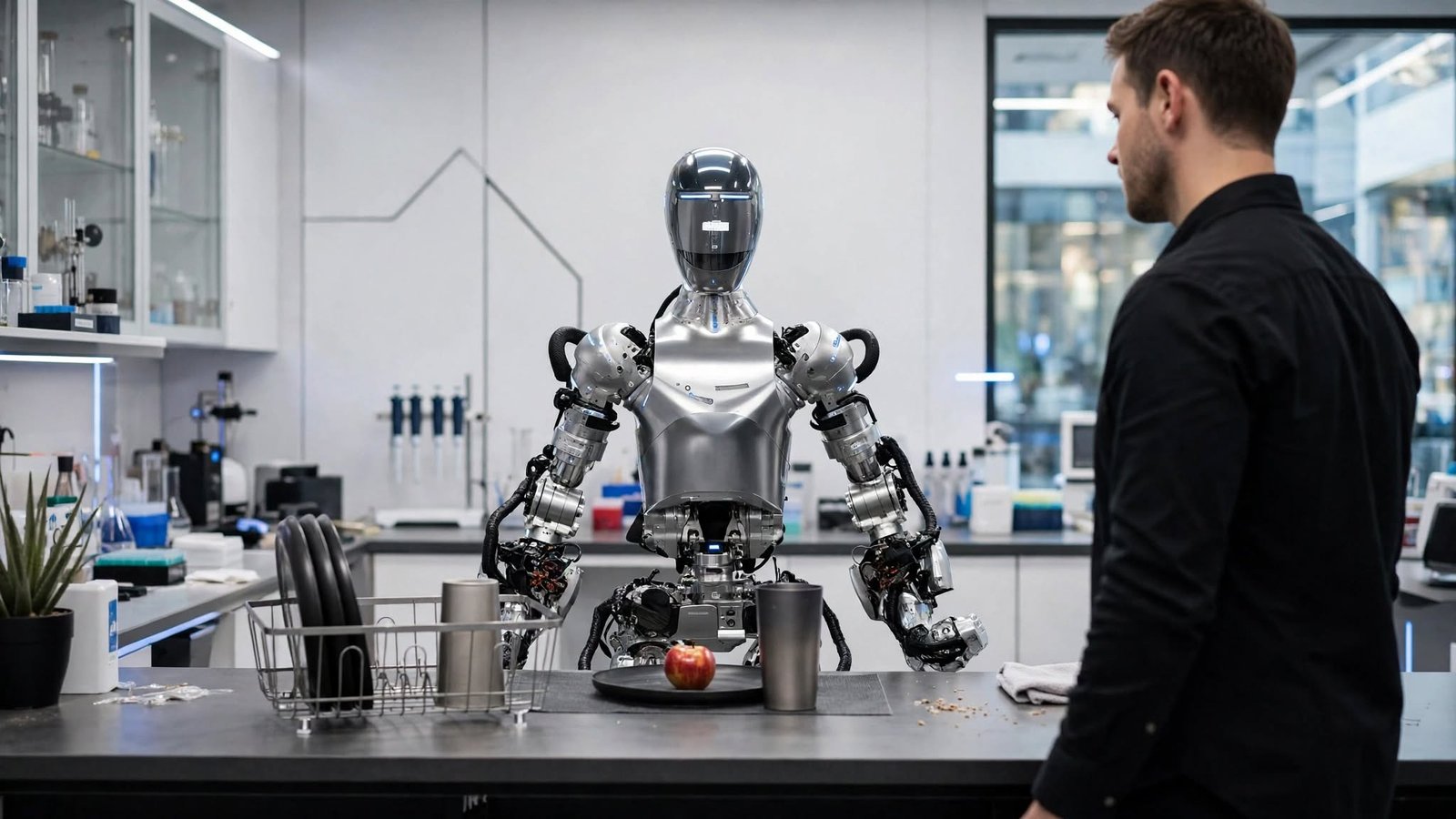
Humanoid robots are becoming more capable as artificial intelligence advances, allowing machines to understand instructions, recognize objects, navigate unfamiliar spaces, and perform tasks that once required direct human control. The biggest change is not simply that robots look more like people, but that they are gradually learning to interact with the world in more flexible and intelligent ways.
How is advanced AI making humanoid robots smarter? AI enables humanoid robots to process visual information, understand human instructions, make informed decisions, and coordinate their movements more effectively. Instead of following only a fixed sequence of programmed commands, modern robots can increasingly interpret their surroundings, respond to changing conditions, and adjust their actions when something unexpected happens.
This progress is attracting attention across manufacturing, logistics, healthcare support, research, and domestic robotics. However, humanoid robots are still developing, and their ability to work safely, reliably, and affordably in everyday environments remains an important challenge.
What Is Driving the Latest Robotics Humanoid News?
The latest developments in humanoid robotics are closely connected to improvements in AI models, sensors, computing hardware, and robotic control systems. In the past, engineers often had to program individual actions for specific situations, which made robots difficult to adapt to new tasks or unfamiliar surroundings. A small change in an object’s position or the layout of a workspace could require additional programming.
Advanced AI is beginning to reduce these limitations by helping robots learn broader patterns from demonstrations, simulated environments, recorded data, and real-world experience. A robot may learn how to recognize a container, reach toward it, grasp it, and move it to another location without needing an entirely separate program for every variation of the task.
Another important development is the integration of multiple AI capabilities into a single robotic platform. A humanoid robot can use cameras to identify objects, language models to interpret instructions, planning systems to determine the next steps, and motion-control software to carry out those steps. These technologies work together to make robot behavior more adaptable, although the quality of the result depends on how well the different systems are integrated.
How Artificial Intelligence Makes Humanoid Robots Smarter
Traditional industrial robots are often designed to perform repetitive movements in controlled environments. Humanoid robots face a more complicated challenge because they must operate in spaces designed for human bodies, where objects move, people change direction, and unexpected obstacles appear throughout the day.
AI helps address this complexity by allowing robots to process information, estimate what is happening around them, and select suitable actions. Rather than treating every situation as a completely new programming problem, an AI-enabled robot can use learned patterns to respond to familiar situations and sometimes generalize those patterns to new ones.
For example, imagine a robot asked to pick up a bottle from a crowded table. It needs to identify the bottle, estimate its position and orientation, determine whether its hand can reach it, select an appropriate grip, and adjust its movement if another object blocks the way. Advanced AI can support each of these stages, while specialized control systems handle the precise physical movements required to complete the task.
The robot may still make mistakes, particularly when lighting is poor, objects are unfamiliar, or its sensors provide incomplete information. Nevertheless, combining perception, reasoning, and physical control represents a significant step toward more practical humanoid machines.
Computer Vision Helps Robots Understand Their Surroundings
Computer vision is one of the most important technologies behind modern humanoid robots. Using cameras and other sensors, a robot can identify objects, estimate distances, recognize surfaces, detect people, and build a representation of the space around it. This information allows the machine to move through an environment and interact with objects rather than relying entirely on predetermined coordinates.
AI-powered vision systems can also help robots distinguish between objects that look similar but require different handling methods. A metal tool, a fragile glass, and a soft package may occupy similar amounts of space, yet each requires a different approach to gripping and movement. Recognizing these differences helps a robot select more appropriate actions.
Visual understanding becomes especially useful when the environment changes. When a worker shifts a box, a door opens across its path, or an object drops to the floor, the robot can reassess its surroundings and adjust its actions accordingly. This flexibility is essential for humanoid robots expected to operate in warehouses, factories, offices, and other shared spaces.
However, computer vision does not provide perfect awareness. Reflective surfaces, transparent objects, unusual lighting, and partially hidden items can still cause errors. Reliable robots therefore need to combine visual information with other sensors and verify that their actions are appropriate before carrying them out.
Language Models Allow Humanoid Robots to Understand Instructions
Another major advancement is the use of AI systems that interpret natural language. Instead of requiring an operator to select every movement through a specialized interface, some humanoid robots can receive instructions expressed in ordinary speech or text. This makes interaction more accessible to people who do not have robotics or programming experience.
For instance, a person might ask a robot to collect several packages and place them near a designated workstation. An AI system can help interpret the request, identify the relevant objects, break the task into smaller actions, and determine which steps need to happen first. The robot then uses its movement-planning and control systems to turn those instructions into precise physical actions.
Language-based interaction can also support clarification when instructions are incomplete. If a person asks the robot to move a container but several containers are nearby, a well-designed system may ask which one the person means instead of making an uncertain choice. This ability to recognize ambiguity is particularly important when the requested action involves fragile equipment, heavy objects, or people nearby.
Still, understanding a sentence is not the same as knowing how to perform the task safely. Language models can misinterpret instructions or suggest actions that are physically impossible, so real-world robots need safeguards, environmental checks, and reliable control mechanisms to prevent an incorrect interpretation from becoming a dangerous movement.
Learning From Demonstrations and Real-World Experience
Humanoid robots can become more capable by learning from examples rather than relying exclusively on manually written instructions. In demonstration-based learning, a human shows a robot how to perform an action, or provides recorded examples from which the system can learn the relationship between what it sees and how it should move.
This approach is useful for tasks involving several coordinated movements, such as opening a cabinet, arranging objects on a shelf, or handling tools. Instead of programming every joint position individually, engineers can train a model using examples of successful behavior and then evaluate whether it can reproduce the task in different circumstances.
Reinforcement learning is another important technique. In this approach, a robot or simulated robot learns through repeated attempts, receiving feedback that encourages successful actions and discourages undesirable outcomes. Simulation is especially valuable because engineers can test many scenarios without exposing expensive hardware to constant collisions, falls, or mechanical wear.
Real-world learning remains difficult, however. A movement that works in a simulated environment may fail when the robot encounters different friction, unexpected weight distribution, sensor noise, or variations in the objects it handles. For that reason, effective training often requires a combination of simulation, demonstrations, carefully collected real-world data, and extensive testing.
Better Movement and Balance Through AI
Walking on two legs is one of the most demanding aspects of humanoid robotics. Unlike wheeled machines, bipedal robots must continuously manage balance, coordinate their legs and upper bodies, and respond to changes in the ground beneath them. Even a seemingly simple activity, such as stepping over an obstacle or turning while carrying an object, requires precise coordination.
AI-assisted control can help robots learn movement patterns and adjust their actions when conditions change. A robot may need to shorten a step on an uneven surface, reposition its feet when carrying a load, or shift its body to maintain stability while reaching for something. These adjustments depend on information from sensors that measure movement, orientation, joint positions, and contact with the ground.
Modern control systems can combine learned movement strategies with physics-based models and fast feedback loops. This combination is important because a robot cannot rely on slow, high-level reasoning for every tiny adjustment needed to remain upright. Balance corrections must often happen quickly, while higher-level AI determines the broader objective.
Despite progress, human-like walking does not automatically mean human-level agility. Running, climbing stairs, recovering from a stumble, working on slippery surfaces, and carrying unpredictable loads remain difficult challenges. Developers must also ensure that improved mobility does not come at the expense of safety or excessive energy consumption.
Why Humanoid Robots Are Becoming More Useful in Factories
Manufacturing is one of the most promising areas for humanoid robots because factories already contain many tools, workstations, shelves, and controls designed around human height and reach. A humanoid platform could potentially move between different work areas and use equipment without requiring every part of the facility to be redesigned for a specialized machine.
AI can help these robots handle tasks that involve moderate variation, such as moving containers, transporting components, sorting certain items, or delivering materials to workers. A robot that can recognize objects and adapt its movements may be more useful than a machine limited to a single repetitive motion, particularly in workplaces where product types and workflows change frequently.
Businesses are also interested in whether humanoid robots can support existing employees rather than simply replace entire roles. Robots could take over physically repetitive, inconvenient, or potentially hazardous activities while people focus on quality checks, complex decisions, equipment maintenance, and tasks that depend on human judgment.
However, the business case depends on more than impressive demonstrations. Companies must evaluate cycle times, reliability, maintenance requirements, safety procedures, operating costs, and the number of tasks a robot can complete without human intervention. For many established production lines, conventional industrial robots remain faster, more predictable, and less expensive for highly specialized operations.
Humanoid Robots in Warehouses and Logistics
Warehouses present a different set of challenges because products come in many shapes and sizes, inventory locations change, and workers frequently share narrow aisles with moving equipment. Humanoid robots equipped with AI could potentially help with picking, moving packages, replenishing shelves, and transporting supplies between work areas.
Visual recognition can help identify packages and storage locations, while navigation systems determine how to travel through the building. AI planning can also help a robot prioritize tasks, respond to blocked routes, or reorganize its actions when a requested item is missing from its expected location.
The potential benefit is flexibility. A company may be able to deploy a robot in an environment already designed for people instead of investing in a completely new automated facility. This is particularly appealing when the building layout changes regularly or when a task requires reaching shelves, handling containers, and moving through human-scale spaces.
Even so, warehouses are demanding environments for autonomous machines. Packages can be damaged, labels may be obscured, aisles can become crowded, and a robot must avoid collisions with people and other vehicles. Successful deployment requires dependable perception, safe movement, clear operating procedures, and a practical way for workers to intervene when the system encounters a problem.
The Role of Generative AI in Humanoid Robotics
Generative AI is expanding the ways people can communicate with robots and the ways developers design robotic behavior. These systems can help interpret open-ended requests, summarize information about a task, generate candidate plans, and connect instructions with the objects and actions available in a robot’s environment.
For example, a person could ask a robot to prepare a workspace by gathering the tools needed for a particular job. A generative AI system might interpret the request, identify likely tools from an inventory, and propose a sequence for retrieving them. The robot would still need to confirm that the selected tools are appropriate and physically carry out the movements through its dedicated control systems.
Generative models may also help engineers create training scenarios and explore alternative ways to complete a task. Combined with simulation, these capabilities can make it easier to test how a robot should respond to different object arrangements, environmental conditions, or instructions.
Nevertheless, generative AI should not be confused with independent physical intelligence. A system that can describe how to lift a heavy object may not be able to estimate its weight accurately, maintain a stable grip, or recognize that the object is unsafe to move. Practical humanoid robots need grounding in sensor data, physical constraints, verification procedures, and safety rules.
How AI Could Bring Humanoid Robots Into Everyday Life
Homes and public spaces are much less predictable than controlled industrial environments. A household robot might encounter pets, children, slippery floors, fragile objects, unfamiliar furniture, and belongings that are left in unexpected places. To be useful, it would need to recognize these situations and behave appropriately without requiring constant supervision.
AI could eventually help humanoid robots perform practical domestic activities, including carrying laundry, collecting household items, moving lightweight objects, and assisting with simple routines. Natural-language interaction may make these systems easier to use because people could describe what they need instead of learning complicated commands.
Yet household assistance involves subtle challenges that are easy to overlook. A robot must distinguish between an object that can be moved and one that should remain untouched, recognize when a task is beyond its capabilities, and avoid damaging property or interfering with people. It may also need to ask for clarification when a request is vague or when several possible actions could produce different outcomes.
Cost, battery life, noise, maintenance, and reliability will also determine whether consumers adopt humanoid robots. For many everyday tasks, a smaller specialized device may be more practical than a machine with a human-like body. Humanoid designs will become compelling when their ability to use existing spaces and equipment offers clear advantages over simpler alternatives.
Safety, Privacy, and Reliability Remain Major Challenges
As humanoid robots become more autonomous, safety must remain central to their design. A robot capable of lifting objects or walking through a crowded workspace can cause harm if its perception fails, its balance becomes unstable, or it misinterprets an instruction. Developers therefore need to combine AI capabilities with physical safeguards, speed and force limits, emergency stops, and systems that detect faults before they lead to accidents.
Reliability is equally important. A robot may perform a task correctly during a controlled demonstration but struggle when lighting changes, an object is damaged, or a person unexpectedly enters its path. Before being trusted with important work, it must demonstrate consistent performance across many realistic conditions and recover safely when something goes wrong.
Privacy also deserves attention, especially when robots operate in homes, hospitals, offices, or other sensitive environments. Cameras and microphones may collect information about people, conversations, personal belongings, and daily routines. Responsible deployment requires appropriate data protection, transparent policies, secure systems, and clear limits on what information is recorded or shared.
There is also the question of accountability. When an autonomous robot makes a harmful mistake, manufacturers, operators, and organizations deploying the system may have different responsibilities. Clear testing standards, documented limitations, worker training, and effective human oversight will help ensure that technological progress is matched by responsible use.
Will Humanoid Robots Replace Human Workers?
Humanoid robots are likely to change some jobs, but widespread replacement of human workers is not an immediate or inevitable outcome. Their strongest near-term opportunities involve structured tasks that are physically demanding, repetitive, or suitable for clearly defined procedures. Even in these settings, the robot must prove that it can perform the work safely and economically.
Many occupations require qualities that remain difficult to reproduce reliably in machines, including nuanced communication, social judgment, creative problem-solving, and the ability to respond sensitively to complex human needs. A robot might assist with transporting materials in a hospital, for example, while nurses and other healthcare professionals continue to provide patient care and make critical clinical decisions.
The more realistic outlook is that workplaces will experiment with different combinations of human labor, conventional automation, and humanoid robots. Some tasks may be automated, some jobs may change, and new roles may emerge in robot supervision, maintenance, training, and integration.
The effects will vary by industry, location, and the pace at which the technology becomes affordable. Businesses and workers will need to consider not only what robots can do, but also how productivity gains, training opportunities, job transitions, and workplace safety are managed.
What to Watch in Robotics Humanoid News in 2026
In 2026, one of the most important developments to watch is whether humanoid robots can move beyond carefully prepared demonstrations and deliver consistent results in real workplaces. Public demonstrations can show what is technically possible, but long-term deployments provide more meaningful evidence about reliability, operating costs, maintenance needs, and performance under ordinary working conditions.
Another key area is the integration of vision-language-action models, which connect what a robot sees with what it understands and how it acts. These systems aim to help robots interpret instructions and translate them into physical behavior, potentially allowing a single platform to handle a wider variety of tasks. Their practical value will depend on how well they generalize to unfamiliar situations and how effectively they are constrained by safety systems.
Developments in battery technology, lighter actuators, tactile sensing, onboard computing, and more efficient control software also deserve attention. Better AI alone cannot overcome the physical limitations of a robot that has insufficient power, limited dexterity, poor balance, or expensive mechanical components. Progress requires advances across the entire machine, from its hardware to the software that coordinates its actions.
Finally, it is worth watching how companies measure success. The most meaningful milestones will include completed tasks, operating hours, intervention rates, safety records, and the total cost of useful work. These measures offer a clearer picture of commercial progress than a robot’s appearance, walking ability, or performance in a short promotional video.
What the Future Holds for Intelligent Humanoid Robots
The future of humanoid robotics will depend on how effectively AI connects intelligent decision-making with dependable physical action. Robots are becoming better at interpreting visual information, understanding instructions, learning from examples, and adapting their movements, creating new possibilities for work in environments built for people.
However, genuine usefulness requires much more than the ability to walk, talk, or demonstrate a complicated movement. A successful humanoid robot must complete valuable tasks repeatedly, operate safely around people, recover from common errors, and justify its cost through measurable benefits.
Over time, improvements in AI models, sensors, hardware, and training methods could make humanoid robots more versatile and accessible. Their adoption is likely to progress unevenly, with structured commercial environments offering opportunities before the more unpredictable demands of everyday household life.
For anyone following robotics humanoid news, the central question is no longer simply whether machines can imitate human movements. It is whether they can reliably understand what needs to be done, determine the safest way to do it, and complete the task in the real world. That combination of intelligence, adaptability, and practical performance will shape the next chapter of humanoid robotics.
