



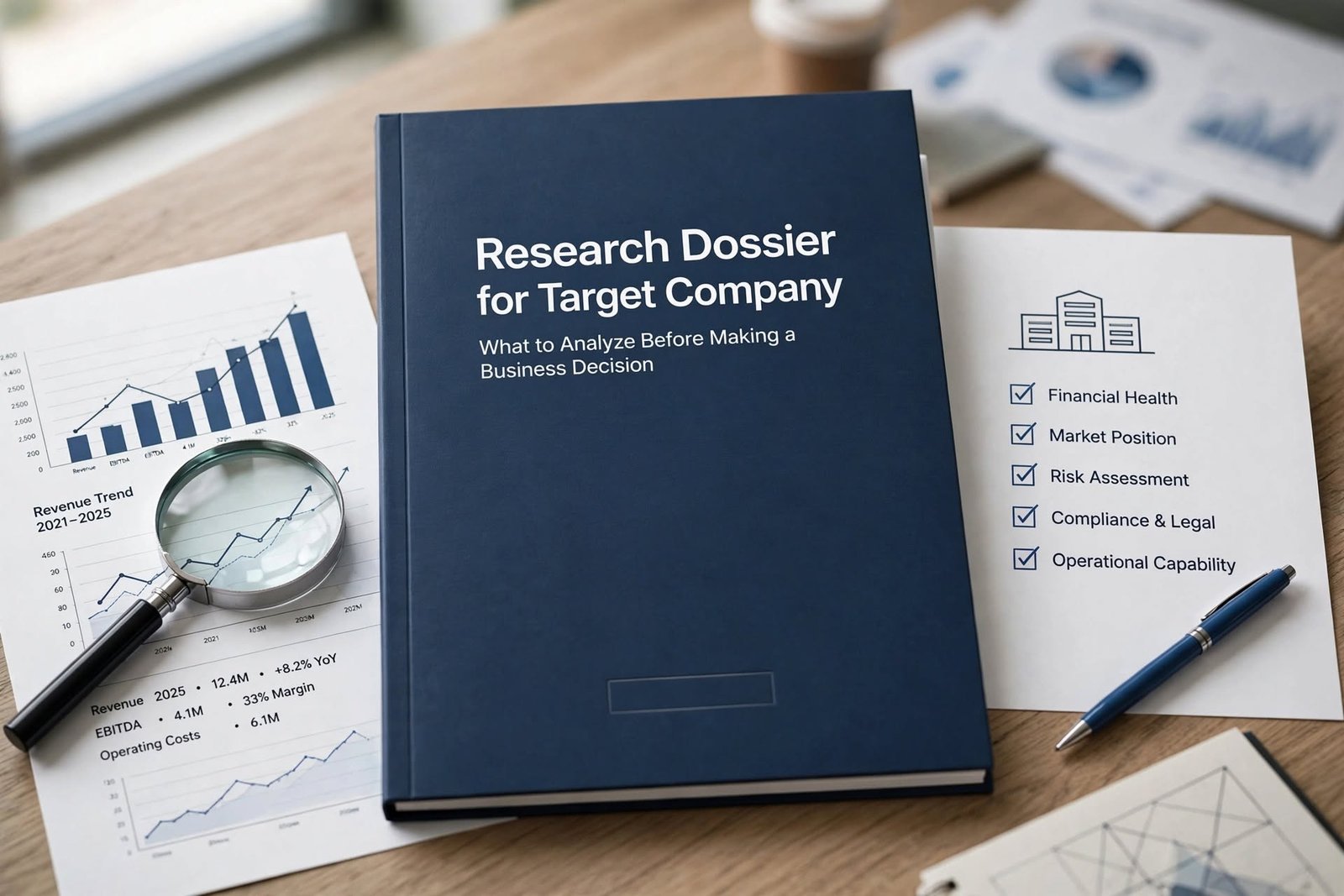
A research dossier for a target company is a structured collection of information designed to provide a clear understanding of a business, its market position, competitors, financial direction, operational model, and future opportunities. Whether the purpose is investment research, acquisition planning, partnership evaluation, market intelligence, or strategic decision-making, a well-prepared dossier brings scattered information together into one coherent picture.
The value of this type of research extends beyond simply describing what a company does. A thorough target company analysis helps identify how the business creates value, where it stands within its industry, what factors influence its performance, and which developments could affect its growth potential.
Understanding the Target Company
The first stage of a research dossier is establishing a strong foundation of information about the target company. This includes its history, ownership structure, headquarters, primary products or services, target customers, business model, geographic presence, and major milestones.
Understanding the company’s background provides context for everything that follows. A company that has expanded rapidly through acquisitions, for example, may require a different analytical approach from a business that has achieved growth primarily through organic expansion.
The company’s mission, positioning, and value proposition should also be examined. These elements can reveal how management wants the organization to be perceived and which customer needs it aims to address.
At the same time, research should distinguish between the company’s stated positioning and its observable market activity. Reviewing products, pricing, customer segments, partnerships, distribution channels, and public business information can provide a more complete picture of how the organization operates in practice.
Analyzing the Company’s Business Model
A company’s business model explains how it generates revenue and converts resources into economic value. A research dossier should therefore examine the company’s principal revenue streams, pricing structure, customer acquisition methods, sales channels, and major operating costs.
For companies with multiple products or services, it is useful to understand which areas contribute most significantly to revenue and growth. This can reveal whether the business depends heavily on one product, customer group, geographic market, or commercial channel.
Recurring revenue can also be an important consideration for businesses operating through subscriptions, contracts, memberships, licensing arrangements, or other repeat-purchase models. The stability and predictability of these revenue sources can differ considerably from businesses that depend primarily on one-time transactions.
Customer concentration deserves attention as well. If a significant portion of revenue comes from a small number of customers, the company may have greater exposure to changes in those relationships. A diversified customer base may provide a different risk profile, although diversification alone does not guarantee consistent performance.
Examining the Target Market
A target company cannot be fully evaluated without understanding the market in which it operates. Market research should consider the size of the relevant industry, historical development, customer demand, geographic trends, purchasing behavior, and factors that may influence future expansion.
Industry growth is particularly important when assessing potential opportunities. A company operating in an expanding market may have opportunities to increase sales simply by capturing additional demand, while a business in a mature or declining market may need to rely more heavily on innovation, market share gains, pricing, or geographic expansion.
Market segmentation can provide additional insight. Customers may differ according to industry, income, company size, location, purchasing requirements, or usage patterns, and these differences can influence the company’s marketing strategy and growth opportunities.
Regulatory conditions, technological developments, economic conditions, and changing consumer preferences should also be considered. These external factors can reshape an industry even when a company’s internal strategy remains unchanged.
Conducting Competitor Analysis
Competitor analysis is one of the most important components of a target company research dossier. The objective is not simply to create a list of competing businesses but to understand how the target company compares with organizations serving similar customers or solving similar problems.
Direct competitors typically offer comparable products or services to the same customer segments. Indirect competitors may satisfy the same underlying customer need through a different product, technology, business model, or distribution approach.
A meaningful competitor analysis examines factors such as product range, pricing, customer experience, brand positioning, geographic reach, distribution, technology, partnerships, and apparent market presence. Publicly available financial and corporate information can add another layer of context where reliable data is available.
The analysis should also consider competitive differentiation. A target company may compete through lower prices, specialized expertise, proprietary technology, convenience, customer relationships, brand reputation, network effects, or a combination of several factors.
Understanding these differences helps explain why customers might choose the target company rather than an alternative. It can also reveal areas where competitors have developed stronger capabilities or where the target company may have room to differentiate itself.
Evaluating Competitive Position
Competitive position describes how the company fits within its broader market environment. This is related to competitor analysis but goes beyond individual comparisons by examining the company’s overall ability to maintain and develop its position.
Factors such as customer loyalty, switching costs, intellectual property, distribution relationships, operational scale, supplier access, technology, and brand recognition can influence competitive strength. The importance of each factor varies considerably by industry.
Barriers to entry should also be investigated. Industries with substantial regulatory requirements, capital requirements, specialized expertise, established networks, or technological barriers may be more difficult for new competitors to enter.
However, barriers can change over time. Technological innovation, new business models, changing regulations, or shifts in customer behavior can lower barriers that once protected established companies.
Reviewing Financial Performance
Financial analysis provides an important quantitative dimension to the research dossier. Depending on the information available, the review may include revenue growth, profitability, operating margins, cash flow, debt, liquidity, capital expenditure, and other relevant financial indicators.
Looking at trends over multiple periods is generally more informative than focusing on a single figure. Consistent revenue growth, for example, can provide different information from a temporary increase caused by an acquisition, unusual market conditions, or a one-time contract.
Profitability should also be considered in context. A rapidly expanding company may intentionally operate with lower margins because it is investing heavily in product development, infrastructure, sales, or geographic expansion.
Cash flow can provide another perspective on financial health. A company can report accounting profits while experiencing significant cash requirements, particularly when working capital, inventory, capital investment, or debt obligations are substantial.
Assessing Growth Potential
Growth potential is one of the central questions addressed by a target company research dossier. Growth may come from increasing sales to existing customers, entering new markets, launching products, expanding distribution, raising prices, improving retention, acquiring competitors, or developing new business models.
The quality of potential growth depends partly on whether the underlying opportunity is scalable. A company may have a large addressable market, but converting that opportunity into sustainable revenue can require substantial investment in employees, technology, infrastructure, marketing, or distribution.
Management’s stated growth plans should therefore be examined alongside the resources required to execute them. Comparing strategic objectives with historical performance, available capital, competitive conditions, and market demand can provide useful context.
Geographic expansion can represent another potential growth avenue. Entering new countries or regions may increase the company’s addressable market, but it can also introduce regulatory, cultural, operational, currency, and competitive challenges.
Investigating Products and Innovation
Products and services are central to understanding how a company competes and grows. Research should examine the current portfolio, product development pipeline, customer adoption, pricing, differentiation, and potential for future innovation.
For technology-oriented businesses, innovation may involve software development, artificial intelligence, automation, intellectual property, data capabilities, or research and development. In other industries, innovation may focus on manufacturing processes, distribution, materials, service delivery, or customer experience.
A strong product portfolio does not necessarily guarantee long-term growth. Products must continue to address relevant customer needs, and companies must respond to changing technologies and competitive alternatives.
The research should therefore consider whether the company’s innovation strategy appears aligned with broader industry developments. This can help identify both potential opportunities and areas of uncertainty.
Examining Management and Corporate Strategy
Management plays a significant role in translating business opportunities into operational results. A research dossier may examine the backgrounds and responsibilities of senior executives, the company’s organizational structure, strategic priorities, and major decisions.
Past strategic actions can provide useful context when assessing current plans. Acquisitions, divestitures, market expansions, product launches, restructuring efforts, and changes in business focus may reveal how management responds to changing conditions.
Corporate strategy should also be considered in relation to available resources. Ambitious expansion plans may require significant capital, specialized employees, technological investment, or new partnerships.
The purpose of this analysis is not to make assumptions about individual executives but to understand documented decisions, strategic priorities, and the resources required to implement them.
Identifying Business Risks
Every target company faces risks, and identifying them is an essential part of comprehensive company research. Common categories include competitive risk, financial risk, regulatory risk, operational risk, technological risk, supply-chain exposure, cybersecurity risk, and customer concentration.
Industry-specific risks can be equally important. A company dependent on commodity prices may be exposed to market volatility, while a regulated business may face changes in legislation or compliance requirements.
External economic conditions can also influence performance. Interest rates, inflation, exchange rates, consumer spending, employment conditions, and international trade developments may affect different businesses in different ways.
A useful dossier should distinguish between risks that are already observable and hypothetical risks that depend on uncertain future events. This helps keep the research evidence-based rather than speculative.
Exploring Opportunities and Market Expansion
Opportunities should be evaluated alongside risks rather than considered separately. Potential opportunities may include new customer segments, emerging technologies, strategic partnerships, international expansion, product extensions, acquisitions, or improvements in operational efficiency.
The size of an opportunity is only one consideration. The company must also possess—or be capable of developing—the resources required to capture it.
For example, entering a large international market may appear attractive based on market size alone, but regulatory requirements, established competitors, localization costs, and distribution challenges may significantly affect the practical opportunity.
This is why a research dossier should connect market opportunities with the company’s existing capabilities. The most meaningful analysis considers not only what could happen but also the conditions that would need to be present for that outcome to occur.
Reviewing Customers and Brand Positioning
Customer research can provide valuable insight into the company’s actual market position. Public reviews, customer testimonials, case studies, retention information, surveys, and other credible sources can help identify recurring themes in customer experience.
Brand positioning should also be examined. A company may compete primarily on price, premium quality, specialist expertise, convenience, innovation, reliability, or customer service.
Understanding this positioning can help explain the company’s relationship with its target audience. It can also reveal whether the brand’s public messaging is consistent with its products, pricing, and customer experience.
Customer sentiment should nevertheless be interpreted carefully. Online reviews and public comments may represent a limited or self-selected portion of the customer base and should not automatically be treated as representative of all customers.
Evaluating Partnerships and Strategic Relationships
Strategic relationships can significantly influence a company’s growth trajectory. Partnerships with suppliers, distributors, technology providers, financial institutions, governments, or other businesses may provide access to capabilities that would otherwise require substantial internal investment.
Research should identify major partnerships and examine their apparent strategic purpose. A technology partnership, for example, may support product development, while a distribution agreement may expand the company’s geographic reach.
The stability and importance of these relationships can also matter. Heavy dependence on a particular supplier, platform, distributor, or strategic partner may create operational exposure if that relationship changes.
Using SWOT Analysis as a Research Framework
A SWOT framework can help organize findings from a broader target company analysis. Strengths and weaknesses generally relate to internal characteristics of the company, while opportunities and threats concern external conditions that may affect its future.
The usefulness of SWOT analysis depends on the quality of the underlying research. Generic statements such as “strong brand” or “high competition” provide limited insight unless they are supported by specific evidence.
A stronger approach connects each observation to documented information. For example, a company’s distribution network, recurring customer base, intellectual property, or geographic footprint may represent relevant internal characteristics, while regulatory changes or industry disruption may represent external factors.
Building a Reliable Research Dossier
A credible research dossier for a target company should rely on information from multiple sources rather than a single website or database. Company reports, regulatory filings, investor materials, official announcements, industry publications, reputable news organizations, market research, and other authoritative sources can provide different perspectives.
Source quality matters because corporate information can sometimes emphasize favorable developments while minimizing uncertainty. Independent sources can provide additional context, although they should also be evaluated for methodology, date, and potential limitations.
The research should clearly separate verified facts from management statements, third-party analysis, and reasonable interpretation. This distinction makes the dossier more useful for readers who need to make informed decisions based on the available evidence.
Turning Research Into Actionable Insights
The final stage is to connect the research findings rather than simply presenting isolated facts. A strong dossier should show how the company’s market, competitors, financial position, strategy, risks, and growth opportunities relate to one another.
For example, rapid market growth may appear attractive, but the company’s ability to benefit from that growth could depend on its competitive position, capital resources, distribution network, and product capabilities.
Likewise, strong historical performance does not automatically establish future performance. Changes in customer behavior, competition, regulation, technology, or economic conditions can alter the environment in which the company operates.
The goal is therefore to create a balanced information base that helps readers understand the company’s current position and the factors that could influence its future direction.
Conclusion
A comprehensive Research Dossier for Target Company provides a structured way to examine a business from multiple perspectives, including its business model, market, competitors, financial performance, management strategy, products, customers, risks, and growth opportunities.
Competitor analysis reveals the environment in which the company operates, while market and financial research helps place its performance into context. Growth analysis then connects these findings to potential future opportunities and the conditions required to pursue them.
When supported by reliable sources and regularly updated information, a target company research dossier becomes more than a collection of facts. It becomes a practical research framework for understanding the business, identifying important questions, and evaluating how changing market conditions may affect its future.
